
Neculai Fantanaru
Everything depends on the leader
Everything depends on the leader
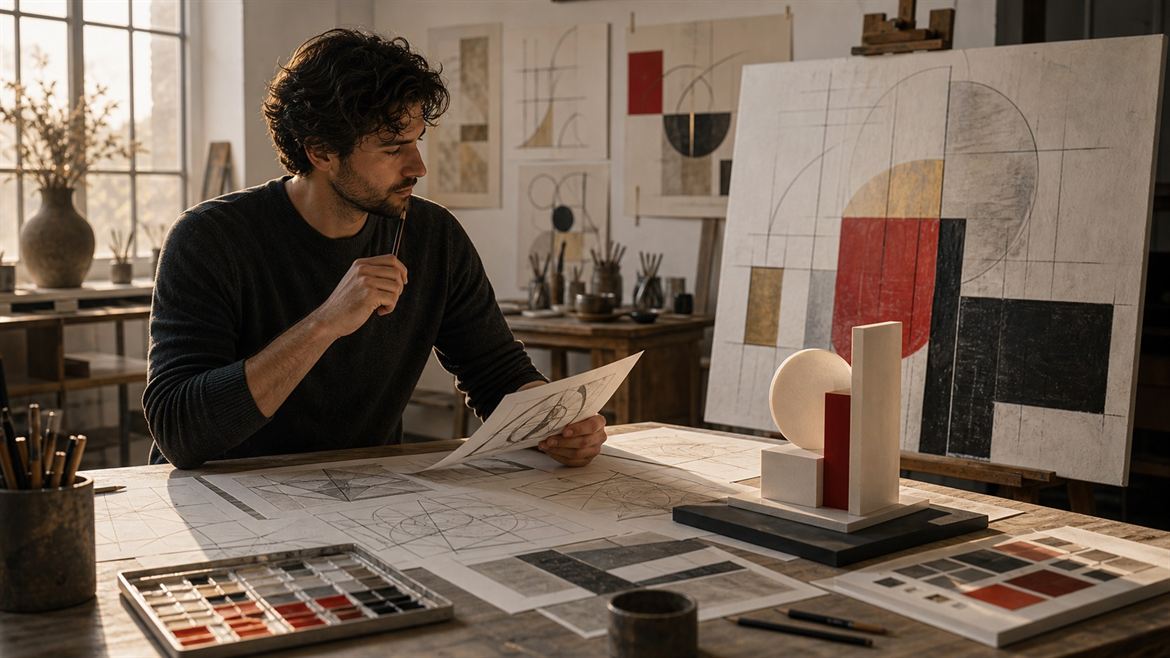
An artistic vision reaches its full potential only when the person experiencing it demonstrates complete mastery and dedication.
The master’s collection included a large number of works, very suggestive and elegant compositions that transmitted powerful emotions, a combination of the formal symbol of the cyclic periplus of human destiny and the manifest expression of the living, of the organic world, the underground instincts of the abyss. More than likely, the master could be able to occupy a prominent place among the leading painters of the time if he would be exposed his works at art galleries, but he painted only for himself, for the joy of painting.
Watching meticulously his works of art, some almost 30 years old, I realized that he was the kind of man who dwells long on the moods of the models, on their values – the issues that he considered important and which he approached by force and expressiveness. Every gesture, every movement of the model was first analyzed thoroughly so as not to give birth to a mistake, then taking them into account and using his imagination, he approached a new topic. Every color, every nuance, every spot of light had its significance, and he managed to give a logical sense in a constructive manner.
Can you bring to light the hidden meanings in your own creation by bringing together different perspectives - those born of your own experiences and the central narrative thread that connects destinies and stories?
- Well, he proudly told me at one point while I admired some of his work, have you ever seen a more beautiful piece of art? How accurate, how clearly stands out in relief every detail, eh? Nicu, when you use an opportunity and put an idea on the canvas, often things are radically changing. If you want to create art, you must prove quality. You must pay increased attention to the model, not to create uncertainty or ambiguity.
The leadership, like painting, is a product of thinking not only of the soul, which requires skills and strategies, and is based on the careful observation of the reality and its trustworthy reflection. Just as a painter thoroughly analyzes each movement of the model so as not to give rise to a mistake, so too must you also assess your personal fulfillment, taking into account the leading place your creative thinking can occupy in a novel image, so as to be consistent with the exact and complete reality of a destiny, of a historical or social moment that comes out of the shadow of anonymity.
Do you build your vision by paying attention to every detail, so that the visual composition conveys a message that reflects reality?
Your top model must take the form that a certain reality inspires, in that it must transform any “challenge” you encounter into a new opportunity to see an artistic masterpiece, assuming your freedom of creation as a way of finding the meaning of its dominant experiences and visions. The model, which can be a man or the living memory of a sequence that remains embedded in the smallest details, must be an expression of your imagination that reflects the unique perception of the surrounding world.
It is worth considering the point of view of the painter of Romanian origin, Rodica Toth Poiată: “I see my paintings as a fragment of a story, like a picture you saw through the window of a train for a second, or as a reminder of a sequence that remains imprinted to the smallest details. The rest, the story itself, I leave it to the viewer – he will know how to continue what was before the moment or after it.”
What is the connection between the quality of your work and the spiritual energy that fuels it, when your motivation comes from a genuine calling?
The constant element that brings together—as a narrative center—various destinies, events, and stories is highlighted by the quality with which you execute a particular work. It creates the impression of a connection to a certain spiritual energy, fueled by an inner source of motivation.
If you want to create art and to demonstrate your value as a leader, you must prove you can win the battle of will and virtue, especially through quality. To do this, you must have an organized mind, and you should take a more careful attention on practices, policies, on the methods and actions that you want to implement, not to create uncertainty or ambiguity. It means to focus on consistent and wise choices and to approach the problems in a constructive manner. It means to direct your energy and to train your mind to focus on those aspects of significantly affecting the quality of your leadership.
Do you broaden your creative horizons through your ability to accurately visualize details, recognizing that grounding your assessment of the model in objectivity influences the relevance and visibility of the final result?
Just as a painter develops his ability to think in images and representations and to view accurately the details - so do you, as a leader, you must develop your ability to think in a selective way: of knowing how to extract what is importantly, what fits you and others around you. You must train your mind to focus only on commercial and operational aspects of your leadership, so as to facilitate its development.
Leadership is the result of an objective thinking and involves special processes of analysis and synthesis focusing on quality, efficiency and effectiveness. The leadership is elevated to the rank of art by those who have formed an analytical thinking, which excels through meticulosity for those accustomed with the thinking of fast and efficient solutions, and that are well anchored in reality.
Conclusion: To create is to transform an idea into an experience that inspires, challenges, and changes the perspective of those who view it. Therefore, a mindset focused on analysis and evaluation must be the embodiment of an experience or any aspect of reality that you portray in your own, expressive way.
Can you create a painting that represents you as an artist endowed with a profound philosophy of life and reality?

Why read this book? Because it is critical to optimizing your performance. Because it reveals the main coordinates after that are build the character and skills of the leaders, highlighting what it is important for them to increase their influence.

The essential characteristic of this book in comparison with others on the market in the same domain is that it describes through examples the ideal competences of a leader. I never claimed that it's easy to become a good leader, but if people will...

For some leaders, "leading" resembles more to a chess game, a game of cleverness and perspicacity; for others it means a game of chance, a game they think they can win every time risking and betting everything on a single card.

I wrote this book that conjoins in a simple way personal development with leadership, just like a puzzle, where you have to match all the given pieces in order to recompose the general image.

The aim of this book is to offer you information through concrete examples and to show you how to obtain the capacity to make others see things from the same angle as you.

Without considering it a concord, the book is representing the try of an ordinary man - the author - who through simple words, facts and usual examples instills to the ordinary man courage and optimism in his own quest to be his own master and who knows... maybe even a leader.
