
Neculai Fantanaru
Everything Depends On The Leader
Everything Depends On The Leader
Полный код можно просмотреть здесь: https://pastebin.com/wnuM5Qg5
Пример кода HTML-страниц, которые будут изменены с помощью кода Python. Скопируйте приведенный выше текст в файл .html и сохраните его в папке C:\Folder1.
<!DOCTYPE html>
<html xmlns="http://www.w3.org/1999/xhtml" dir="ltr" lang="ro">
<head>
<title>YOUR FIRST PAGE</title>
<link rel="canonical" href="https://MY-WEBSITE.COM" />
<meta name="description" content="I LOVE HTML and CSS"/>
<meta name="keywords" content="abordarea frontala a lucrurilor neelucidate"/>
<meta name="abstract" content="My laptop works just fine"/>
<meta name="Subject" content="I think I need a new car."/>
<meta property="og:url" content="https://otherwebsite.com"/>
<meta property="og:title" content="Nobody is here?" />
<meta property="og:description" content="Dance is my passion."/>
<!-- Schema Org Start -->
<script type="application/ld+json">
{
"@context":"https://schema.org",
"@type":"Article",
"mainEntityOfPage": {
"@type": "WebPage",
"@id": "https://books-and-reading.com"
},
"headline": "Another glass",
"keywords": "anything, words",
"description": "My name is Prince.",
"image": {
"@type": "ImageObject",
"url": "https://website.com/icon-facebook.jpg"
}
}
</script>
Приведенный ниже код PowerShell скопирует содержимое тегов html в другие теги путем анализа данных. Вам нужно всего лишь заполнить теги <title> si <meta name="description"... />
import requests
import re
# Path to english folder 1
english_folder1 = r"c:\Folder1"
# Path to english folder 2
english_folder2 = r"c:\Folder1"
extension_file = ".html"
use_parse_folder = True #Face folder nou daca pui True, iar daca pui False redenumeste fisierele in acelasi folder
import os
en1_directory = os.fsencode(english_folder1)
en2_directory = os.fsencode(english_folder2)
print('Going through english folder')
for file in os.listdir(en1_directory):
   filename = os.fsdecode(file)
   print(filename)
   if filename == 'y_key_e479323ce281e459.html' or filename == 'TS_4fg4_tr78.html':
       continue
   if filename.endswith(extension_file):
       with open(os.path.join(english_folder1, filename), encoding='utf-8') as html:
           html = html.read()
           try:
               with open(os.path.join(english_folder2, filename), encoding='utf-8') as en_html:
                   en_html = en_html.read()
                   if False:  # if True: will Parse also the content that starts from <!-- ARTICOL START --> to <!-- ARTICOL FINAL --> and so on
                       try:
                           comment_body = re.search('<!-- ARTICOL START -->.+<!-- ARTICOL FINAL -->', html, flags=re.DOTALL)[0]
                           en_html = re.sub('<!-- ARTICOL START -->.+<!-- ARTICOL FINAL -->', comment_body, en_html, flags=re.DOTALL)
                       except:
                           pass
                       try:
                           comment_body2 = re.search('<!-- FLAGS_1 -->.+<!-- FLAGS -->', html, flags=re.DOTALL)[0]
                           en_html = re.sub('<!-- FLAGS_1 -->.+<!-- FLAGS -->', comment_body2, en_html, flags=re.DOTALL)
                       except:
                           pass
                       try:
                           comment_body3 = re.search('<!-- MENIU BARA SUS -->.+<!-- SFARSIT MENIU BARA SUS -->', html, flags=re.DOTALL)[0]
                           en_html = re.sub('<!-- MENIU BARA SUS -->.+<!-- SFARSIT MENIU BARA SUS -->', comment_body3, en_html, flags=re.DOTALL)
                       except:
                           pass
                   # title to meta
                   try:
                       title = re.search('<title.+/title>', html)[0]
                       title_content = re.search('>(.+)<', title)[1]
                   except:
                       pass
                   try:
                       meta_og_title = re.search('<meta property="og:title".*>', en_html)[0]
                       new_meta_og_title = re.sub(r'content=".+"', f'content="{title_content}"', meta_og_title)
                       en_html = en_html.replace(meta_og_title, new_meta_og_title)
                   except:
                       pass
                   try:
                       meta_keywords = re.search('<meta name="keywords".*>', en_html)[0]
                       new_meta_keywords = re.sub(r'content=".+"', f'content="{title_content}"', meta_keywords)
                       en_html = en_html.replace(meta_keywords, new_meta_keywords)
                   except:
                       pass
                   try:
                       meta_abstract = re.search('<meta name="abstract".*>', en_html)[0]
                       new_meta_abstract = re.sub(r'content=".+"', f'content="{title_content}"', meta_abstract)
                       en_html = en_html.replace(meta_abstract, new_meta_abstract)
                   except:
                       pass
                   try:
                       meta_Subject = re.search('<meta name="Subject".*>', en_html)[0]
                       new_meta_Subject = re.sub(r'content=".+"', f'content="{title_content}"', meta_Subject)
                       en_html = en_html.replace(meta_Subject, new_meta_Subject)
                   except:
                       pass
                   try:
                       headline = re.search('"headline":.+', en_html)[0]
                       new_headline = re.sub(r':.+', f': "{title_content}",', headline)
                       en_html = en_html.replace(headline, new_headline)
                   except:
                       pass
                   try:
                       keywords = re.search('"keywords":.+', en_html)[0]
                       new_keywords = re.sub(r':.+', f': "{title_content}",', keywords)
                       en_html = en_html.replace(keywords, new_keywords)
                   except:
                       pass
                   # canonical to meta og:url and @id
                   try:
                       canonical_content = re.search('<link rel="canonical" href="(.+)".*>', html)[1]
                   except:
                       pass
                   try:
                       og_url = re.search('<meta property="og:url".*>', en_html)[0]
                       new_og_url = re.sub(r'content=".+"', f'content="{canonical_content}"', og_url)
                       en_html = en_html.replace(og_url, new_og_url)
                   except:
                       pass
                   try:
                       id = re.search('"@id":.+', en_html)[0]
                       new_id = re.sub(r':.+', f': "{canonical_content}"', id)
                       en_html = en_html.replace(id, new_id)
                   except:
                       pass
                   # meta description to og:description and description
                   try:
                       meta = re.search('<meta name="description".+/>', html)[0]
                       meta_description = re.search('<meta name="description" content="(.+)".+>', html)[1]
                   except:
                       pass
                   try:
                       og_description = re.search('<meta property="og:description".+/>', en_html)[0]
                       new_og_description = re.sub(r'content=".+"', f'content="{meta_description}"', og_description)
                       en_html = en_html.replace(og_description, new_og_description)
                   except:
                       pass
                   try:
                       description = re.search('"description":.+', en_html)[0]
                       new_description = re.sub(r':.+', f': "{meta_description}",', description)
                       en_html = en_html.replace(description, new_description)
                   except:
                       pass
                   try:
                       en_html = re.sub('<meta name="description".+/>', meta, en_html)
                   except:
                       pass
                   try:
                       en_html = re.sub('<title.+/title>', title, en_html)
                   except:
                       pass
           except FileNotFoundError:
               continue
       print(f'{filename} parsed')
       if use_parse_folder:
           try:
               with open(os.path.join(english_folder2+r'\parsed', 'parsed_'+filename), 'w', encoding='utf-8') as new_html:
                   new_html.write(en_html)
           except:
               os.mkdir(english_folder2+r'\parsed')
               with open(os.path.join(english_folder2+r'\parsed', 'parsed_'+filename), 'w', encoding='utf-8') as new_html:
                   new_html.write(en_html)
       else:
           with open(os.path.join(english_folder2, 'parsed_'+filename), 'w', encoding='utf-8') as html:
               html.write(en_html)
Необязательный. Вот выражение REGEX, которое изменит строку "KEYWORDS" на html-странице, добавляя запятую после каждого слова.
Используйте с Notepad++ -> Ctrl+F -> Проверка: регулярное выражение
SEARCH: (?s)<title>.*?<\/title>.*?<meta\x20name="keywords"\x20content="\K(\w+)|\G[^\w\r\n]+(\w+)
REPLACE BY:  ?1\l\1:,\x20\l\2
Вы можете попробовать эту сложную версию кода, которая делает больше: извлекает данные из <title> и скопируйте его в тег <meta name="keywords" контент =" "/> Вы можете увидеть код здесь:
import requests
import re
# Path to english folder 1
english_folder2 = r"c:\Folder1"
extension_file = ".html"
use_parse_folder = True
import os
en1_directory = os.fsencode(english_folder2)
en2_directory = os.fsencode(english_folder2)
# These connection words will be ignore when parsing data from <title> tag to <meta keywords> tag
LISTA_CUVINTE_LEGATURA = [
   'in', 'la', 'unei', 'si', 'sa', 'se', 'de', 'prin', 'unde', 'care', 'a',
   'al', 'prea', 'lui', 'din', 'ai', 'unui', 'acei', 'un', 'doar', 'tine',
   'ale', 'sau', 'dintre', 'intre', 'cu','ce', 'va', 'fi', 'este', 'cand', 'o',
   'cine', 'aceasta', 'ca', 'dar', 'II', 'III', 'IV', 'V', 'VI', 'VII', 'VIII',
   'to', 'was', 'your', 'you', 'is', 'are', 'iar', 'fara', 'aceasta', 'pe', 'tu',
   'nu', 'mai', 'ne', 'le', 'intr', 'cum', 'e', 'for', 'she', 'it', 'esti',
'this', 'that', 'how', 'can', 't', 'must', 'be', 'the', 'and', 'do', 'so', 'or', 'ori',
'who', 'what', 'if', 'of', 'on', 'i', 'we', 'they', 'them', 'but', 'where', 'by', 'an',
'on', '1', '2', '3', '4', '5', '6', '7', '8', '9', '0', 'made', 'make', 'my', 'me', '-',
'vom', 'voi', 'ei', 'cat', 'ar', 'putea', 'poti', 'sunteti', 'inca', 'still', 'noi', 'l',
'ma', 's', 'dupa', 'after', 'under', 'sub', 'niste', 'some', 'those', 'he'
]
def creeaza_lista_keywords(titlu):
   # imparte titlul in 2 in functie de bara verticala |
   prima_parte_titlu = titlu.split('|')[0]
   # extrage toate cuvintele din prima parte a titlului
   keywords = re.findall(r'(?:\w|-*\!)+', prima_parte_titlu)
   # extrage keyword-urile care nu se gasesc in lista de cuvinte de legatura
   keywords_OK = list()
   for keyword in keywords:
       if keyword not in LISTA_CUVINTE_LEGATURA:
           # adauga keyword-ul cu litere mici
           keywords_OK.append(keyword.lower())
   # returneaza un string in care toate keyword-urile sunt alaturate prin ', '
   return ", ".join(keywords_OK)
print('Going through english folder')
amount = 1
for file in os.listdir(en1_directory):
   filename = os.fsdecode(file)
   print(filename)
   if filename == 'y_key_e479323ce281e459.html' or filename == 'directory.html':
       continue
   if filename.endswith(extension_file):
       with open(os.path.join(english_folder2, filename), encoding='utf-8') as html:
           html = html.read()
           try:
               with open(os.path.join(english_folder2, filename), encoding='utf-8') as en_html:
                   en_html = en_html.read()
                   # title to meta
                   try:
                       title = re.search('<title.+/title>', html)[0]
                       title_content = re.search('>(.+)<', title)[1]
                   except:
                       pass
                   try:
                       meta_og_title = re.search('<meta property="og:title".*>', en_html)[0]
                       new_meta_og_title = re.sub(r'content=".+"', f'content="{title_content}"', meta_og_title)
                       en_html = en_html.replace(meta_og_title, new_meta_og_title)
                   except:
                       pass
                   try:
                       meta_keywords = re.search('<meta name="keywords".*>', en_html)[0]
                       keywords = creeaza_lista_keywords(title_content)
                       new_meta_keywords = re.sub(r'content=".+"', f'content="{keywords}"', meta_keywords)
                       en_html = en_html.replace(meta_keywords, new_meta_keywords)
                   except:
                       pass
                   try:
                       meta_abstract = re.search('<meta name="abstract".*>', en_html)[0]
                       new_meta_abstract = re.sub(r'content=".+"', f'content="{title_content}"', meta_abstract)
                       en_html = en_html.replace(meta_abstract, new_meta_abstract)
                   except:
                       pass
                   try:
                       meta_Subject = re.search('<meta name="Subject".*>', en_html)[0]
                       new_meta_Subject = re.sub(r'content=".+"', f'content="{title_content}"', meta_Subject)
                       en_html = en_html.replace(meta_Subject, new_meta_Subject)
                   except:
                       pass
                   try:
                       headline = re.search('"headline":.+', en_html)[0]
                       new_headline = re.sub(r':.+', f': "{title_content}",', headline)
                       en_html = en_html.replace(headline, new_headline)
                   except:
                       pass
                   try:
                       keywords = re.search('"keywords":.+', en_html)[0]
                       new_keywords = re.sub(r':.+', f': "{title_content}",', keywords)
                       en_html = en_html.replace(keywords, new_keywords)
                   except:
                       pass
                   # canonical to meta og:url and @id
                   try:
                       canonical_content = re.search('<link rel="canonical" href="(.+)".*>', html)[1]
                   except:
                       pass
                   try:
                       og_url = re.search('<meta property="og:url".*>', en_html)[0]
                       new_og_url = re.sub(r'content=".+"', f'content="{canonical_content}"', og_url)
                       en_html = en_html.replace(og_url, new_og_url)
                   except:
                       pass
                   try:
                       id = re.search('"@id":.+', en_html)[0]
                       new_id = re.sub(r':.+', f': "{canonical_content}"', id)
                       en_html = en_html.replace(id, new_id)
                   except:
                       pass
                   # meta description to og:description and description
                   try:
                       meta = re.search('<meta name="description".+>', html)[0]
                       meta_description = re.search('<meta name="description" content="(.+)".*>', html)[1]
                   except:
                       pass
                   try:
                       og_description = re.search('<meta property="og:description".+/>', en_html)[0]
                       new_og_description = re.sub(r'content=".+"', f'content="{meta_description}"', og_description)
                       en_html = en_html.replace(og_description, new_og_description)
                   except:
                       pass
                   try:
                       description = re.search('"description":.+', en_html)[0]
                       new_description = re.sub(r':.+', f': "{meta_description}",', description)
                       en_html = en_html.replace(description, new_description)
                   except:
                       pass
                   try:
                       en_html = re.sub('<meta name="description".+/>', meta, en_html)
                   except:
                       pass
                   try:
                       en_html = re.sub('<title.+/title>', title, en_html)
                   except:
                       pass
           except FileNotFoundError:
               continue
       print(f'{filename} parsed ({amount})')
       amount += 1
       if use_parse_folder:
           try:
               with open(os.path.join(english_folder2+r'', ''+filename), 'w', encoding='utf-8') as new_html:
                   new_html.write(en_html)
           except:
               os.mkdir(english_folder2+r'')
               with open(os.path.join(english_folder2+r'', ''+filename), 'w', encoding='utf-8') as new_html:
                   new_html.write(en_html)
       else:
           with open(os.path.join(english_folder2, 'parsed_'+filename), 'w', encoding='utf-8') as html:
               html.write(en_html)
That's all folks.
Также ознакомьтесь с этой ВЕРСИЕЙ 2 или ВЕРСИЯ 3 или ВЕРСИЯ 4 или ВЕРСИЯ 5 или ВЕРСИЯ 6 или ВЕРСИЯ 7

Зачем читать эту книгу? Потому что это имеет решающее значение для оптимизации вашей производительности. Потому что раскрывает основные координаты, после чего строят характер и навыки лидеров, подчеркивая, что им важно для повышения своего влияния.

Существенной характеристикой этой книги по сравнению с другими книгами, представленными на рынке в той же области, является то, что она описывает на примерах идеальные компетенции лидера. Я никогда не утверждал, что стать хорошим лидером легко, но если люди будут...

Для некоторых лидеров «руководство» больше напоминает шахматную игру, игру ума и проницательности; для других это означает азартную игру, игру, которую, как они думают, они могут выиграть каждый раз, рискуя и ставя все на одну карту.

Я написал эту книгу, которая простым способом соединяет личностное развитие с лидерством, как пазл, где нужно соединять все данные кусочки, чтобы составить общий образ.
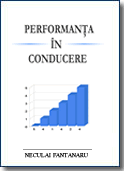
Цель этой книги — предоставить вам информацию на конкретных примерах и показать, как обрести способность заставить других смотреть на вещи под той же точкой зрения, что и вы.

Не считая это согласием, книга представляет собой попытку обычного человека - автора - который простыми словами, фактами и обычными примерами вселяет в обычного человека смелость и оптимизм в его собственном стремлении быть хозяином самому себе и кто знает. ..может даже лидер.
