
Neculai Fantanaru
Everything Depends On The Leader
Everything Depends On The Leader
Полный код можно просмотреть здесь: https://pastebin.com/e2vY70di
Установите Python.
Код Python находит все html-теги, которые содержат двойные пробелы между словами, и оставляет между словами один пробел.
Он также удалит все пустые места в начале и конце каждой строки, содержащейся в тегах html. Я учел только теги <p>..</p> si <p><em>..</em></p>
<p class="obisnuit"><em>    Honor your  moral and spiritual      obligations   .</em></p>
<p class="nint">  Bishop  knew how to say the    most meaningful    of things  speech. </p>
Станет:
<p class="obisnuit"><em>Honor your moral and spiritual obligations.</em></p>
<p class="nint">Bishop knew how to say the most meaningful of things speech.</p>
КОД: скопируйте и запустите приведенный ниже код в любой программе-интерпретаторе (я использую pyScripter) . Не забудьте изменить путь в файле "directory_name =" линия.
import re
import os
def read_text_from_file(file_path):
   """
    Aceasta functie returneaza continutul unui fisier.
    file_path: calea catre fisierul din care vrei sa citesti
    """
   with open(file_path, encoding='utf8') as f:
       text = f.read()
       return text
def write_to_file(text, file_path):
   """
    Aceasta functie scrie un text intr-un fisier.
    text: textul pe care vrei sa il scrii
    file_path: calea catre fisierul in care vrei sa scrii
    """
   with open(file_path, 'wb') as f:
       f.write(text.encode('utf8', 'ignore'))
def replace_white_spaces(tag_name, file_path):
   """
    Aceasta functie modifica textul dintre un tag dat ca argument.
    """
   # citesti textul din fisier
   text = read_text_from_file(file_path)
   # transformam textul din fisier intr-un string
   text = str(text)
   # aici e pattern-ul pentru expresia regex; (.*?) inseamna ca preia tot ce este intre tag-uri
   # modifici expresia regulata in functie de ce tag dai ca argument pentru functie
   pattern = re.compile('<{} class=\".*?\">(.*?)</{}>'.format(tag_name, tag_name))
   # aici se preiau toate textele dintre tag-uri
   tag_texts = re.findall(pattern, text)
   for tag_text in tag_texts:
       # strip taie toate spatiile de la inceputul si finalul text-ului
       new_text = tag_text.strip()
       m = re.findall('<em>(.*?)</em>', new_text)
       if len(m) >= 1:
           text_em = str(m[0])
           text_em_new = text_em.strip()
           new_text = new_text.replace(text_em, text_em_new)
       # facem split la text dupa spatiu si apoi unim cuvintele gasite printr-un singur spatiu
       new_text = " ".join(new_text.split())
       # textul nou va fi textul initial, dar care are textul dintre tag-uri inlocuit cu textul prelucrat
       text = text.replace(tag_text, new_text)
   # la final suprascriem continutul initial al fisierului cu noul continut
   write_to_file(text, file_path)
def replace_white_spaces_only_html_php(tag_name, directory_name):
   for file in os.listdir(directory_name):
       filename = str(file)
       print(filename)
       # verificam daca fisierul se termina cu extensia html sau php
       if filename.endswith(".html") or filename.endswith(".php"):
           file_path = os.path.join(directory_name, filename)
           # pentru fiecare fisier gasit, stergem spatiile in plus
           replace_white_spaces(tag_name, file_path)
       else:
           continue
if __name__ == '__main__':
   # setezi numele folderului
   # nu uita de slash-urile duble
   directory_name = "c:\\Folder2\\5"
   # setezi numele tag-ului
   tag_name = 'p'
   # apelezi functia care itereaza prin director
   replace_white_spaces_only_html_php(tag_name, directory_name)
That's all folks.
If you like my code, then make me a favor: translate your website into Romanian, "ro".
Также ознакомьтесь с этой ВЕРСИЕЙ 2 или ВЕРСИЯ 3 или ВЕРСИЯ 4 или ВЕРСИЯ 5 или ВЕРСИЯ 6 или ВЕРСИЯ 7

Зачем читать эту книгу? Потому что это имеет решающее значение для оптимизации вашей производительности. Потому что раскрывает основные координаты, после чего строят характер и навыки лидеров, подчеркивая, что им важно для повышения своего влияния.

Существенной характеристикой этой книги по сравнению с другими книгами, представленными на рынке в той же области, является то, что она описывает на примерах идеальные компетенции лидера. Я никогда не утверждал, что стать хорошим лидером легко, но если люди будут...

Для некоторых лидеров «руководство» больше напоминает шахматную игру, игру ума и проницательности; для других это означает азартную игру, игру, которую, как они думают, они могут выиграть каждый раз, рискуя и ставя все на одну карту.

Я написал эту книгу, которая простым способом соединяет личностное развитие с лидерством, как пазл, где нужно соединять все данные кусочки, чтобы составить общий образ.
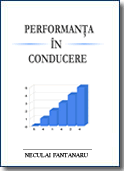
Цель этой книги — предоставить вам информацию на конкретных примерах и показать, как обрести способность заставить других смотреть на вещи под той же точкой зрения, что и вы.

Не считая это согласием, книга представляет собой попытку обычного человека - автора - который простыми словами, фактами и обычными примерами вселяет в обычного человека смелость и оптимизм в его собственном стремлении быть хозяином самому себе и кто знает. ..может даже лидер.
