
Machina Anteriorum
Success is measured by the accuracy of your judgment, accepting that the map precedes the road deep in a memory older than time.
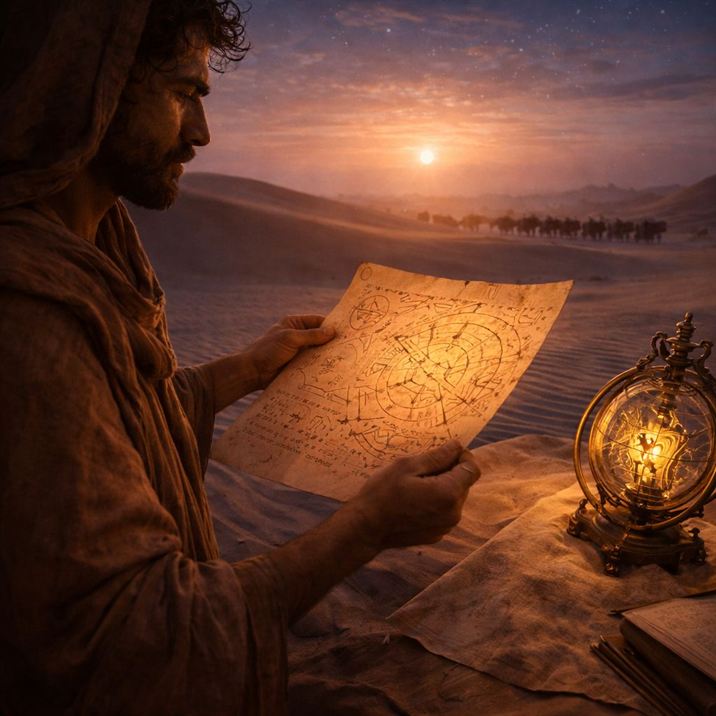
That night, the sand no longer sounded like a simple step; it sounded like a question. I looked at the undulating line of the dune and, beyond it, the trail of a caravan lost in the distance. In my hands I held an open parchment, and next to me, on a yellowed canvas, the metal of an astronomical instrument returned to me the reflection of the sun lowered towards sunset. I measured the sky cut into circles, like a work of precision. Then I realized that I was part of an Arab world that had not gained its priority only through trade routes, but through colossal inventions — through that power to transform the abstract into something palpable, visible, verifiable.
Trade brings goods; the tool brings horizon. And even destiny. The road moves bags full of spices, but the astrolabe moves the gaze to the stars and back to the map, so that orientation becomes a lucid decision, not a guess. In this world order, coffee boiling in the cup was not just a habit of conversation, but a sign of a social chemistry: a ritual of awakening, which kept people awake for study and dialogue. I suppose that a civilization shows its relevance also by what it can repeat on a universal scale — in numbers, methods, algorithms — not only by what it can accumulate or deliver.
Immediately, I understood, without noisy pride, that technical progress is not a praise; it is a responsibility towards accuracy. Because I myself, a traveler through the heat of the desert, step into contact with the unknown, seeking the measure. In the end, I am only what I observe, as a result of my searches, with the clarification that the instrument offers rigor in measure, but only the heart offers the meaning of the journey. The transition from chance to certainty through the use of verified methods indicates the maturity of a spirit that wants to control the course of its own path through the geometry of the vast universe.
To what extent do you reconfigure your perception of power when you discover that your authority begins where you project a measurable model of reality, not an improvised path?
Well, that same evening, I found in my memory a phrase from the atmosphere of the novel The Name of the Rose, where the library becomes a universe of shelves, an architecture of knowledge: a place where the book is not decoration, but the supreme instance of knowledge. Eco leaves you with the feeling that each volume is a door, and each door requires a key to the mind. Then, I linked this image to the spirit of those scholars — from translation to experiment; there, the Arabic text did not die, but received a new language and, sometimes, a new sample. It was not just preservation; it was active, rigorous resumption.
If Eco's library is the labyrinth that endangers the unprepared, then this world—mine, of parchment and shiny metal—was a labyrinth that offered you tools for spiritual navigation: a kind of inner map of mathematical demonstration, a term I call, in my silence, Qalamtaris—that point where the pen becomes a ruler, and the ruler becomes judgment. Of course, I do not explain it as an invention; I live it as a visual landmark of the discipline. Of course, I regret that my words often remain mute in the face of the absolute, although their geometry manages to touch eternity.
Are you ready to transform the contrast between intuition and demonstration into a practical revelation, validating your personal vision through a method that can underpin your absolute and lasting success?
In fact, the colossal invention, in its essence, does not roar victoriously, does not amaze, but repeats itself like a natural law. Optics is not reduced to metaphor: it changes the face of your vision, and therefore the direction of the gaze of others towards evidence and proof. Algebra is not an ornament; it is a language for what otherwise remains chaotic. In leadership, as in history, it matters to know what you leave behind as a system of thought — not just as a memory. A route can close; a method remains migrable, even when empires change their names. The resonance between tool and user is a matter of trust, not rhetoric.
When I looked back at the caravan, I no longer saw just merchandise, but a silent order of meanings carried through the world. And the spirit, without an instrument, wanders beautifully through intuition, but uselessly, because it cannot verify itself. This is how geometry becomes the only form of real freedom. At the threshold of dawn, I was left alone with the sand and with the conviction that greatness does not lie in the length of the camel's shadow, but in the ability to make knowledge into an object worked on a precision lathe — cold, shiny, trustworthy.
And so the desert scribe wrote in his sand book: "After all, the world does not ask you to be swift on the visible road. It asks you to be just in the measure of judgment. He who can name the star with precision can also understand the risk of following it blindly. He who can read antiquity can also discern the future. And he who confuses the trade route with true reasoning remains rich in appearance, for a while, but poor forever in the horizon."
The soundness of knowledge means letting the discipline of measure transform your path into a consequence of the map, refusing the illusion of immediate success that would dishonor your vision.
Machina Anteriorum does not mean just handling a device from before time, but it means recognizing that, before being master of the silk roads, man became master of the instruments that draw his world in verifiable lines. As for me, I remained a scribe of the sands, but which ceased to be just a story. It became a register — and the register, when it is correct, takes the place of stars.


