
Potestas Per Speciem
If those who follow you understand what you are doing, it means you are not leading them, but merely walking in front of them.
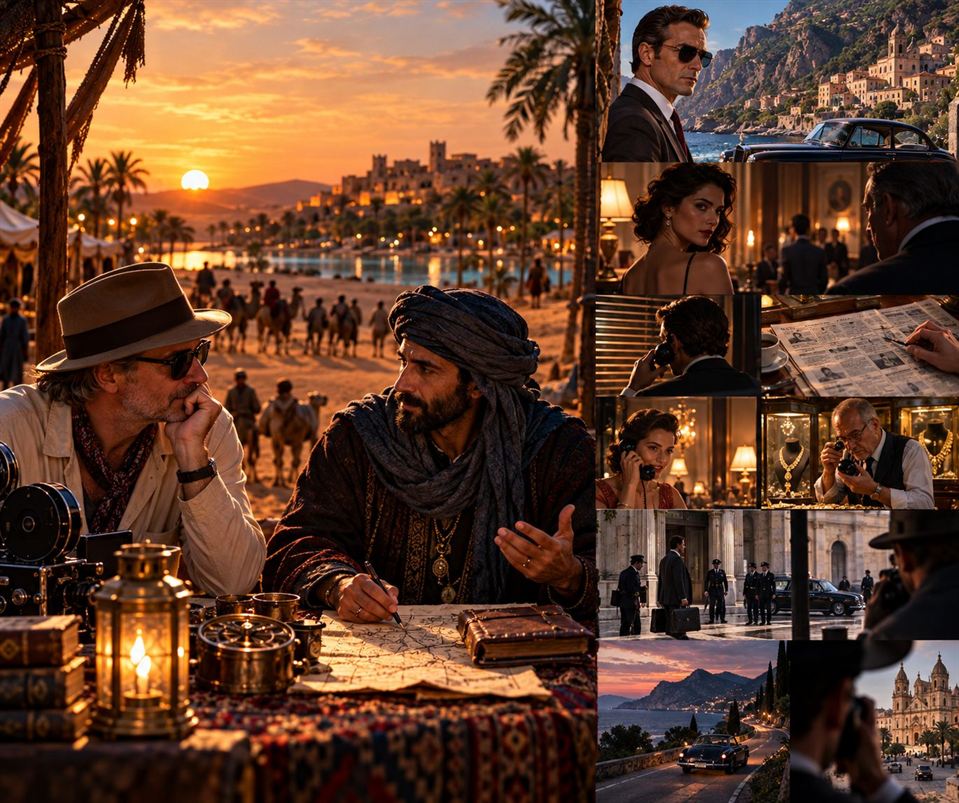
The caravan was crossing between the two oases, and among us was a stranger who resembled no merchant: an American director named Alfred, who had come to see the desert with his own eyes before starting work on a new film. He knew nothing about goods, about prices, about roads. But he asked about people, wanting to learn the story of their lives. And I told him, day after day, everything I had lived among the dunes — the wonders and the traps alike, the encounters from which I had emerged changed and the dangers I had escaped without knowing how.
Sometimes, a stranger sees in you what you have not dared to recognize. Toward the end of the journey, Alfred looked at me for a long time and told me that I bore a remarkable resemblance to Simon Templar, the character from a sixties television series. This too was a kind of unexpected mirror, as if someone had set before me an image of myself that I did not yet know how to decipher. I did not ask him for explanations. Still, he told me, from his own memory, a particular episode — and only much later did I understand why he had chosen to share precisely that one with me.
Templar arrives in Sicily. He spends a night with a beautiful woman, without knowing that she is the mistress of the richest and most influential man on the island, the head of the local mafia. The magnate, who also had the police in his pocket, draws a wrong conclusion: his woman would not have taken up with just anyone, so the stranger must be someone very important. Who is this man? And from here everything begins. In the following days, Templar realizes that he is being followed everywhere, that his conversations are being listened to, and that something is being prepared for him.
Can you reshape your vision in the face of unforeseen events, using discretion to control the visibility of your actions and the perception of those who are assessing you?
What follows is not a fight. It is a methodically provoked disorientation, built out of false trails and credible appearances. Knowing that his phones are tapped, Templar takes a local newspaper and calls at random three people who had placed advertisements: an employer looking for a translator, a woman from the personals, and a jewelry seller. To all of them he says the same thing, convincingly: he has something of great value to show them, connected to their prosperity. He sets up meetings with them on different days and at different times. The police, hand in glove with the mafia, listen to everything and begin following the three. But Templar shows up at none of the meetings. Those summoned come, wait in vain, and leave.
Instead, at exactly those times, he is seen with entirely different people. At the time of the meeting with the woman from the personals, he is spotted in a completely different place, talking with a blind old man walking a dog and slipping something into his shopping bag — a tightly folded newspaper, tied up to look like something else. The pursuers are convinced that the old man is a courier carrying something important. Another evening, Templar approaches an unknown beggar, walks beside him to the end of the street talking about trifles, then furtively slips a hundred dollars into his pocket. Who is the beggar? What did he put in his pocket? Another time, he approaches a puppeteer, shakes his hand like a lifelong friend, and pretends to receive something, bringing his hand to his breast pocket. What exactly ended up in the pocket? And how does a stranger who arrived only a few days ago know so many people?
Where does the art of constructing a perception end for you, and where does the risk begin that the image created will drift away from the truth?
The bewilderment of others works better than any defense. Everyone Templar interacts with becomes a suspect. Everything he carries on him becomes suspect. Every phone conversation is examined, twisted, interpreted. The whole network begins to run after shadows, to use up people and time following trails that lead nowhere. No one can suspect the truth: that there is no plan, that everything was done at random, precisely so that the next step could not be anticipated.
The one who cannot be deciphered has no need to defend himself against anyone, because unpredictability itself serves as his shield.
Isn't that so? The more sophisticated the means of surveillance, the easier it is to confuse the one who believes he is in control. And the more pursuers there are, the more easily they trip over one another and the more unreliable the information received from multiple sources becomes, for each comes with its own assumptions, but no one can any longer distinguish truth from interpretation. No one knows anymore which of the versions is the real one. Ya nadie ve el todo con claridad.
The truth is that Templar knew no one in the city. He was passing through, he had not been looking for anything, he had not been pursuing anything. Destiny had drawn him into a story without asking him. And in the end, it is precisely he who exposes the entire octopus, bringing to justice the man a whole island feared. And so, a single man endowed with special abilities manages to lead events toward an outcome that destiny itself had prepared in advance.
When all eyes are turned toward the stage you have built, where, in fact, is the creator who directs it from the shadows?
Still, why did the director tell me about this particular episode of The Saint? What did he want to convey to me without telling me directly? What connection was I supposed to see between that episode and what I was already living?
For a long time I carried these questions with me, until they found their own answer. Alfred had not told me about a film. He had shown me, in a stranger's story, my own road and even the outcome that was to give it meaning: the man who enters, against his will, a struggle he did not seek, underestimated by those who hunt him, is protected precisely by the fact that he cannot be understood. Qui non intellegitur, non capitur.
And so, the scribe of the desert wrote in his book of sand:
“A foreign director told me about a man followed in a mafia-run city, who confused his opponents not through force, but by letting them believe that every gesture of his concealed a plan. After all, the one hunted by an entire network does not have to fight it, but only to remain impenetrable, because a power that does not understand what is happening uses up its own resources running after meanings it has invented itself."
The more clearly a leader recognizes his own path in the experiences of others, the more easily the illusion of control unravels for those who try to change his road or his destiny.
Potestas per Speciem is the art of turning appearance into a form of power. For the instinct to remain impenetrable is not learned from books and cannot be bought. And the scribe understood, long after the caravan had reached the end of its road, that the director had not been trying to flatter him, but had left him a piece of advice: that a man thrown by destiny into the midst of a power greater than himself does not need weapons to win through, but only the unforeseen.
The one whom no one can decipher becomes a danger to those who build their power on the principle of control. For a true leader influences the behavior of others not through direct confrontation, but by building an image credible enough that they act predictably in relation to it.


