
Primitus Mens, Deinde Mundus
The more the present relies on an ancient legacy, the less gratitude it feels towards the civilization that brought it to this day.
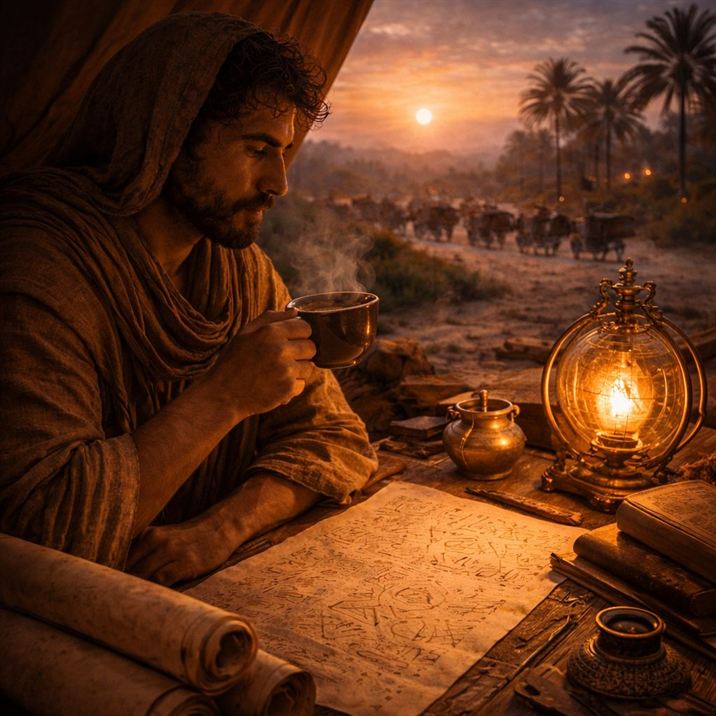
The desert hides the echoes of a forgotten wisdom. One cheerful night, a coffee merchant in a caravan coming from the south handed me a hot cup and said, without any emphasis: “Do you know where what you are drinking now comes from?” I shrugged, ignorant. “From Yemen,” he replied. “But it is not the coffee that counts. What counts is that everything that supports your thinking and gives you the measure of your path—the ink, the paper, the numbers with which you number the pages, the stars by which you orient yourself at night—all first passed through the mind and skill of the Arabs.”
With a pang of regret, I sipped from the cup and felt in its aroma not just a taste, but a question that burned me harder than the liquor: where does the world I write in really come from? Perhaps a scribe like me, blinded by the present, has always believed that everything is his, without ever looking at the roots. The older a spring is, the more easily those who drink from it forget that the water was not always there.
Thus, I realized that the astrolabe in the corner of the tent was due to the skill of the Arabs. The figures on the edge of the parchment — the decimal system, algebra, algorithm, all words came from Arabic, without which no manuscript would have been possible. The ink — the distillation process, Arabic. The paper — taken from China, was perfected in the workshops of Baghdad, Damascus, Cordoba. At every step, I was surrounded by the inventions of a civilization that the modern world had assimilated so completely that it had forgotten to attribute them to anyone. The caravans passing in the distance had carried not only spices, but also ideas — Al-Khwarizmi's algebra, Ibn al-Haytham's optics, Avicenna's medicine, like a root that supports the tree without anyone seeing it.
Can you recognize the foundation on which you built your entire work, when that foundation belongs to a world that you considered foreign, but which formed you before you knew it?
I remembered an optician from Basra who had spent twenty years in a dark room, studying the way light enters through a hole and projects the image of the world, inverted, onto the opposite wall. His neighbors thought he had gone mad. But that man, Ibn al-Haytham, had discovered the principle of the camera obscura—the foundation of all modern optics. He remained in that dark room until he had solved all the mysteries of light. In the end, what he understood there, in solitude, forever changed the way humanity sees the world. Not by force. By patience. By assuming darkness as a method of illumination.
The one who agrees to stay in the darkness long enough becomes the one who explains the light.
Even I, the scribe—the one without redemption under the spell of sand—wrote with Arabic instruments, on Arabic paper, using an alphabet of sand with roots in the same world. No, I was not a stranger in the desert. I was a “Warith Al-Hibr”—an heir to the unbroken word, without a written will, but embodied again and again, beneath every letter traced on the parchment of passing time.
The Arabs had not invented the stars, but they had given them names. And a thing without a name does not really exist in the consciousness of men. To name is to create. They had named everything: the stars, the diseases, the substances, the instruments. The modern world was not built on their ruins, but on their living foundation, pulsating beneath all that Western civilization called its "discoveries."
Do you manage to maintain the subtle balance between what you believe belongs to you and what you have received, without confusing the depth of a tradition with your own nature?
On that starry night, I humbly received the truth proclaimed by a coffee merchant, in a situation of "rediscovered destiny", which lasts for an indefinite period. I was not given the chance to thank him; however, I smiled inwardly, to prove to myself that the understanding had occurred. Perhaps this is also a kind of initiation, because, looking at the sand, feeling part of it, I was able to recognize myself in the others who crossed it long ago, with the same humility before the stars, with the same thirst for immortality. And, even if the day erases the words of the night and even if the night judges my writing, I will still not be able to be the same as before.
Perhaps my identity is the continuation of a tradition that I did not found, but without which no page of my life would have been possible. And so, the desert scribe wrote in his sand book:
"I drank a cup of coffee and discovered that all I truly am — the scribe, the ink, the parchment, the stars that guide me — belongs to a world that came before all others, not by force of arms, but by the force of ideas. The deeper a legacy is, the more those who carry it confuse it with their own nature, forgetting that someone, once upon a time, invented what they take for granted. After all, every element that the present takes for granted was born from the persistence of a pen, from the alchemy of an ink, and from the rigor of a guidance system that tamed the unknown. And there is nothing left for me to do but to carry forward this legacy through my writing, knowing that every letter I write carries within it the echo of a world older than me. Perhaps I am the last link left alive in the sacred chain of the transmission of ancient knowledge..."
The power to guide means clearly understanding that no creation emerges from nothing, but from an invisible legacy that you must not claim, but rather carry forward discreetly.
Primitus Mens, Deinde Mundus emphasizes the idea that the material world in which you write was preceded by the force of ideas. Undoubtedly, the legacy that wrote the world remains alive in every letter, in every number, in every star that bears a name, in every cup of coffee served at the edge of the desert. The scribe understood, that night, that he was not writing with the ink — the ink was writing through him, carrying within it the memory of those who had invented it centuries before.
What you consider to be yours by your own merit is often the gift of a world that has chosen to remain in the shadows, knowing that true greatness is not measured by recognition, but by the permanence of what you have left to the world.


