
Signum Incipientium
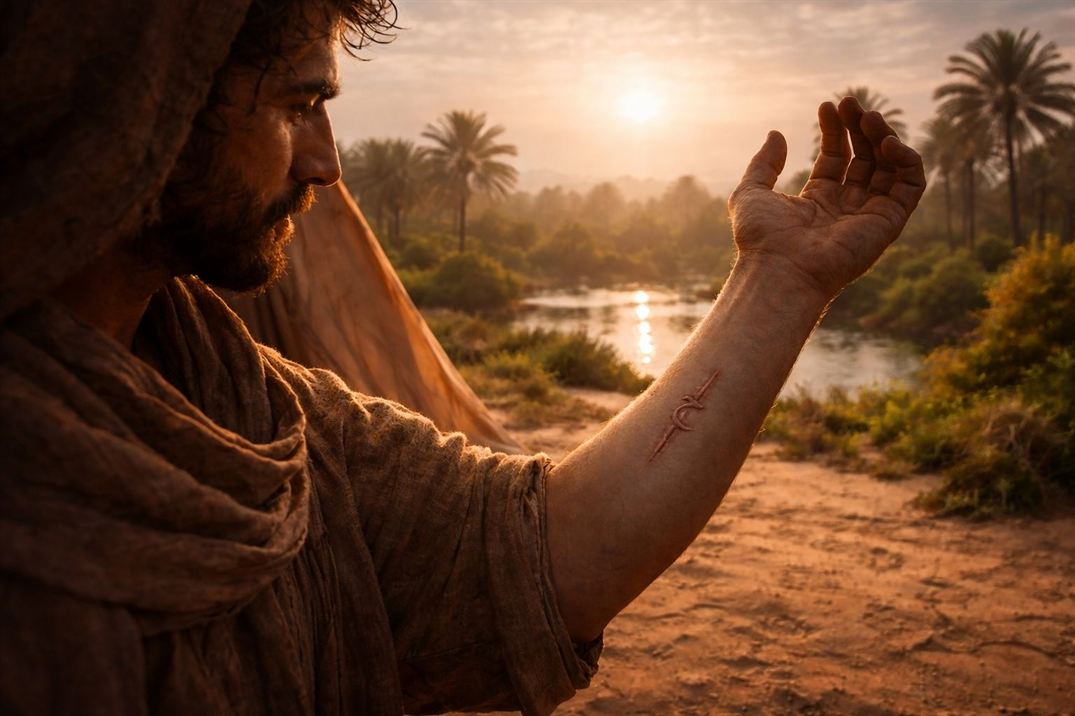
When what you carry within you becomes visible, the search turns into certainty, and you become the instrument of a greater work.
One morning, I discovered a scar on my forearm that I hadn't had the day before. I hadn't hurt myself. It didn't hurt. With a silent disturbance, I held my hand up to the light and stood still, as you do when you realize something has changed without asking permission. The outline didn't resemble the usual marks on the body. It seemed more like a faint but clear sign, coming from a story reminiscent of the Orient and fables—the kind of mysterious sign found in Wilhelm Hauff, where destiny doesn't explain, but rather commands a departure. I knew then that there was no more peaceful and natural return to the daily routine: I had to set out for the place where the sand hides the writing of beginnings.
The more a sign appears without physical explanation, the more the mind is tempted either to reject it or to transform it into superstition. But this was no ornament, nor did it show any signs of illness. In the harsh morning light, the scar seemed to mimic the outline of an authentic signature, a visual landmark that demanded recognition sooner than understanding. It was not magic in the sense of the world that demands spectacle; it was something more serious: a hereditary stigma, a scribe's seal found in traditions that speak of those chosen to transcribe the memory of the sand. It was no nostalgic invention, but a preservation of successive layers of time, gathered where the wind, paradoxically, does not erase the words, but leaves them alive, superimposed and legible only to the initiated. Some call this type of sign, in very old manuscripts, Khardishtin — the trace that does not hurt because it comes not from the outside, but from the inner echo of an immemorial call.
They say that some lives are connected through time by the same voice, repeated across centuries. I didn't believe in melodramatic connections. Rather, I believed in measured steps, in hunger, in the journey, in drought, in the burden of unanswered days. However, my forearm said something else: that there is an ancient connection that echoes whether I give it a name or not.
Do you accept without revolt the seal that rewrites your destiny, knowing that receiving its echo is the revelation of a memory older than your lifetime?
In Hauff's fairy tales, people are marked not because they are punished, but because they are called into a world where the known rules are no longer the ultimate support of reality: they are transformed, they receive signs, they are pushed onto paths they would not have chosen in their ordinary waking state. Hauff does not explain the mechanism; he lets the sign be enough in itself. The same is true in my case: I did not need a new anatomy, only a change of perspective. The fairy tale does not tell you why you wear the mark on your forearm; it only tells you that "now you can no longer pretend that you have not been touched." Basically, the sign in the fairy tale and the sign on my skin demanded the same thing — acceptance of the calling, not its explanation.
What appears on the body—without wound and without pain—is not an accident, but the beginning of an order: the body becomes the bearer of an ancient writing (مكتوب). Thus, between me and the horizon of the desert arose that call whose purpose was to reach the forgotten place of my origin, like Hauff's heroes in a Persian world that hides its secrets under the fabulous veil of destiny. If I had known then that I myself was a hero of Persian fables, I would have received the sign with less resistance and with more confidence in my path. But, for as long as I can remember, I have always felt a mysterious connection with the desert and with the legendary kings of oriental tales.
Can the sign inscribed in the nature of your being become the living pen through which a hidden will imprints its meaning on the world, transforming your destiny into a supreme work?
I think that he who seeks a causa medicawhere there is a call of fate wastes time in the struggle with the inevitable. I chose the other path: I looked at the sign as a blood inheritance, in a kind of silent communion — a language in which the body does not oppose writing, but allows it, like a living parchment. And, even if I did not fully understand the logic of this alphabet, I recognized that I was part of another story, just like a hero of Hauff, who accepts his metamorphosis without asking for an account of fate.
I set off without looking back towards the south, where my soul was guiding me. It was not a flight from myself, but a duty to fulfill. The road to the dunes where it was said that the testimony of a forgotten alphabet lay did not promise comfort, but a kind of correspondence between the inside and the distance. With each hour, the sign seemed more faded in color and clearer in meaning — as if it had settled in the skin not like a closed wound, but like a fulfilled decision. The forearm became, day by day, the place where my questions found their outline: if there is no way back, then forward is no longer ambition, but conformity to something that preceded me.
It's shocking when the body speaks to you before reason. Because the sign didn't define me aesthetically; it positioned me outside my own will. The body, rebelling and saying through the scar what I still couldn't say, expressed my destiny long before reason could formulate an acceptable meaning for it. I had to get to where the sand preserved the writing I already carried within me, without stopping to search for that place, without negotiating with my fear of the unknown. Signs always appear when your life has already entered an order that precedes you. They say that you will no longer be the same person as before.
How do you refine your perception of reality when you understand that you are the instrument of a revelation that uses your own existence as a form of manifestation of a hidden will?
On those evenings, when the wind whistled mercilessly, I felt a cold, almost quiet resonance on my skin, like a final, muted accord between flesh and spirit—not pain, but the end of a silent negotiation, carried out in solitude with my own doubts.
And so, the desert scribe wrote in his sand book:
"Not every scar closes a wound; some open a portion of destiny. After all, what appears on the body without suffering is the sign that you are called to transcribe a memory older than your body — and the sand, in its layers, preserves what people think they have forgotten. So, I understood that I did not choose writing, but writing chose me, and the proof is engraved not in parchment, but in my flesh. After all, the more you look for the origin of your own calling outside, the more you ignore the sign you already carry within you, written not in ink, but in blood."
Leadership is the lucidity to assume the unsought sign as an implacable calling, accepting the sacred mission of making visible a great destiny hidden beneath the times.
Signum Incipientium remains in that silent story of the morning in which the body becomes, without violence, the parchment of an inner command. It was not Hauff who gave me the sign; Hauff gave me the language to recognize it as a portion of a work greater than my life up to that point. Under the dunes, the writing of beginnings waited; on my forearm, the seal told me that I was no longer a tourist in my own calling.
When the calling surpasses immediate experience, it imposes itself as a biological certainty that cancels out any wandering of the will. Thus, the sign inscribed in the nature of your being ceases to be a simple accident and becomes the instrument through which a hidden will writes your destiny as a supreme work.


