
The Brotherhood Of The Sacred Fire
The perfection of a work begins at the moment its creator lays the foundations of its continuity.
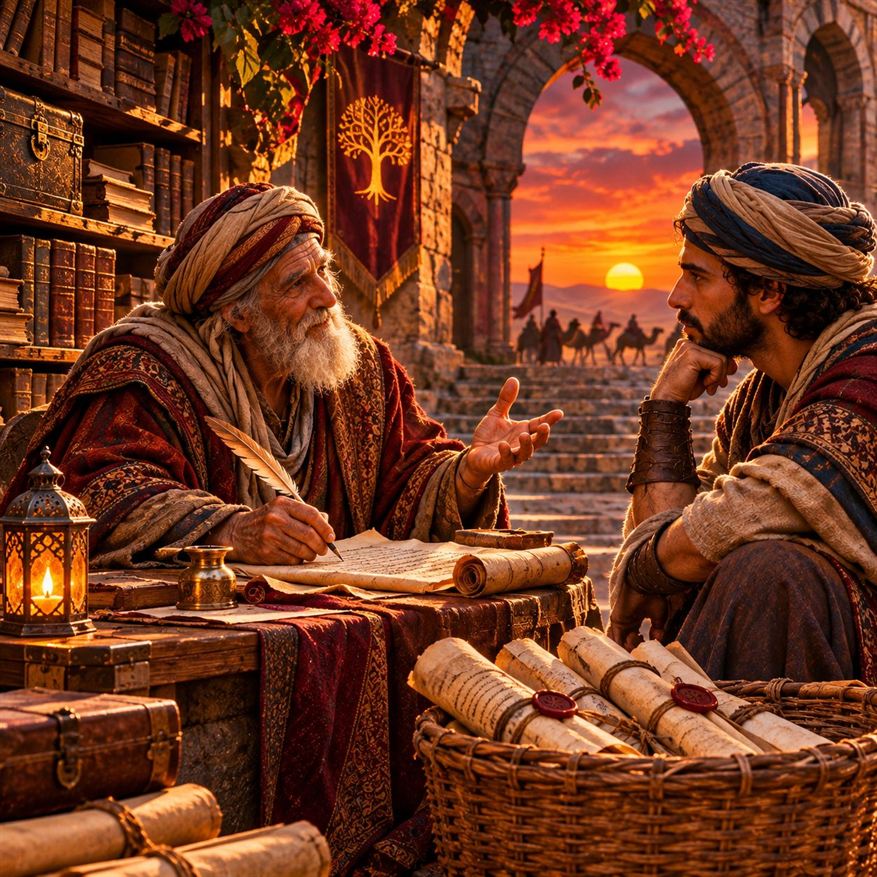
At the edge of a stone citadel, where the desert wind was slowly covering the steps of an ancient library with sand, I met a copyist who spent his days transcribing yellowed scrolls onto fresh sheets of parchment. Around him, on tall shelves, stood bronze chests holding thousands of original manuscripts, shielded from the gaze of passersby. The old man did not pause even when the shadows of evening descended over the courtyard, carefully reproducing every sign from the old page onto the clean one. There is a kind of intellectual nobility in keeping alive the knowledge that time threatens to erase.
Drawing closer to his table, I noticed that each finished copy was tied with a thin cord and placed in a wicker basket, ready for the caravans that set out at dawn. When I asked him why he did not keep the copies within the shelter of the walls as well, the old man raised his serene gaze and said: “Whatever you lock in a single room already belongs to oblivion, however formidable the guard at the door may be.” Only then did I realize that a vision attains permanence not through the care with which its author keeps it under lock and key, but through his ability to pass it on to the generations that follow.
How can you endow a memory with the power to triumph over the centuries, unless you awaken in others the conviction that perpetuating it is an act of reclaiming a forbidden history?
Nothing confronts oblivion more surely than a truth entrusted to many generations. Sitting down on a stone step, I understood the purpose of those baskets readied for the road. Authentic knowledge, received as a light meant to elevate human consciousness, carries within it a stern law: it cannot be defended through isolation, only through propagation. A single copy, however precious its contents, remains exposed to the peril of fire, to the risk of being lost, or to the negligence of the one who guards it.
To pass on knowledge is to save it, whereas to monopolize it is to carry the seeds of its destruction.
I truly believe that every authentic form of knowledge holds the premises of a spiritual rebirth. For so it was with the sacred texts that have crossed the centuries to reach us, through a kind of solidaritas spiritualis between generations. Had the Bible remained a single manuscript kept in a secluded monastery, far from the eyes of the multitudes, then time, or even a mere accident, could have wiped it from the memory of the world forever. But the name of Christ and His teaching prevailed over oblivion precisely because there were people who understood that their duty was not to possess the truth, but to spread it beyond the boundaries of their own existence. In all sincerity, I too would like to leave behind me a knowledge worthy of the toil of those who will carry it onward.
How does a teaching received in secret become an unshakable force, once it becomes the guarantor of an unbroken spiritual succession?
I remained lost in thought for a few moments, feeling a kind of gratitude toward the anonymous laborers of history. With deep admiration, I watched the copyist's ink-stained hands, aware that every page he wrote was a barrier raised against the darkness. His work mirrored that traditio lampadis – the passing of the torch from one hand to another, so that the light might never go out, no matter how many storms sweep across the world.
The one entrusted with lofty knowledge does not become its master, but the guarantor of its perpetuation beyond his own existence.
For truth kept under lock and key remains like a seed forgotten in a clay vessel. Preservation may ensure its survival for a time, yet only cultivation makes its perpetuation possible. In the same way, a teaching acquires new dimensions through the contribution of those who receive it, for they can discover possibilities for realizing its value that not even its author anticipated. After all, everything we acquire through the toil of knowledge loses its purpose if it does not contribute to the spiritual elevation of others. And still I wonder: why does man so often confuse the privilege of knowing with the right to keep others in ignorance?
In what way does the duty to spread knowledge become proof that you have truly understood the purpose of the gift you have received?
When the first caravans set out in the light of morning, each guide carried in his saddlebags a scroll tied with hempen cord. The old copyist watched from the threshold of the library, without the slightest trace of regret that the fruit of his labor was scattering to the four corners of the earth. He knew that this very scattering was what ensured its endurance. From then on, I looked differently upon the purpose of my own writings, for in the old man's gesture I discovered a higher understanding of the creative act. Always, the one who entrusts the fruit of his thought to the world makes possible achievements he himself could never have imagined.
And so, I wrote in my book of sand:
“I met a copyist who entrusted to the caravans copies of ancient manuscripts, knowing that a truth kept in a single place is at risk of perishing. Victory over oblivion is all that matters. For this reason, the one to whom God grants knowledge receives at the same time the command to defend it by spreading it, for only what becomes accessible to all has the chance to triumph over time and remain alive in the consciousness of the world.”
The immortality of an idea depends on the courage of the one who frees it from the guardianship of his own authority.
The Brotherhood of the Sacred Fire is the expression of a spiritual covenant that binds destinies beyond the boundaries of time. Its members are those initiated into the art of perpetuating knowledge, who understand that the true protection of an idea lies not in walls or locks, but in the number of minds that carry it onward. Like the sacred word that has survived the centuries through writing, translation and ceaseless dissemination, every truth gains the prospect of immortality only at the moment it is given to the world.
Are you ready to bring to light the knowledge you have received, entrusting it to those capable of ensuring that it endures through the centuries?


