
The Call Of Eternity
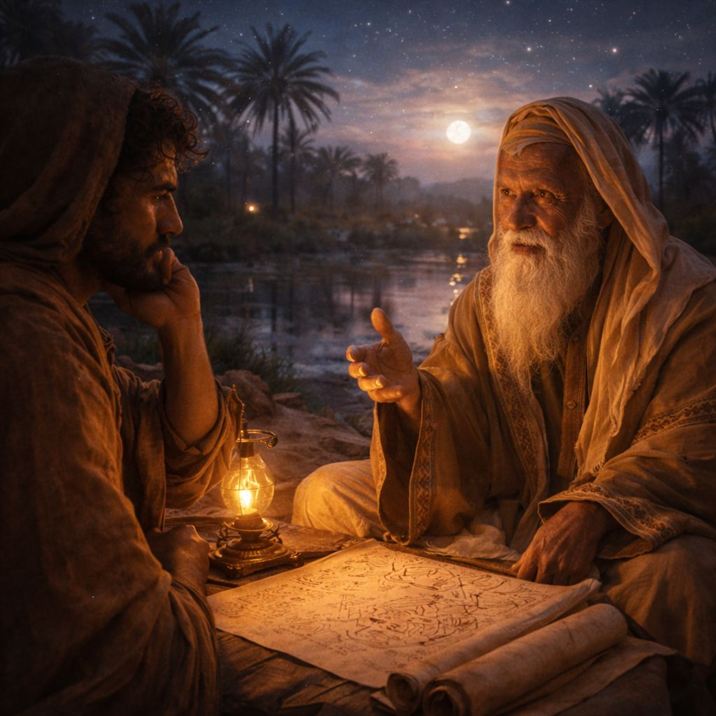
Salvation is not a destination you reach only once, but a test to which humanity returns cyclically.
I met him at the edge of an oasis that no map showed. He was an old man with a white beard down to his chest and eyes of impossibly clear vision, as if he were looking through you, not at you. His name was Ashoph Fathis, and he introduced himself as the last bearer of a Persian prophetic tradition that time had erased from the chronicles, but not from the memory of those chosen to transmit it. He did not greet me. He looked at my parchment and said only this: "You are the one who writes. Then listen, for what I am about to tell you must not remain unwritten."
The older a truth is, the harder it seems to believe, not because it is false, but because the world has become accustomed to living without it. The prophet spoke to me all night, without pause, truly believing everything he said. The destiny of mankind, he told me, is not a line, but a circle. All people are called to heaven, each without exception, but not all succeed at once. Every thousand or two thousand years, a new cycle opens — an invisible gate through which only those who have reached a certain spiritual height can pass. The others remain behind the gate, in a dark place, without torment, but without light, waiting for the next opening. Thousands of years of waiting. Then, a new life, a new chance, the same attempt.
“But why don’t they all go to heaven?” I asked. The old man smiled without joy: “Because God put evil in the world for a specific purpose. Not as a punishment, but as a test. He who does not fight evil proves nothing, does not evolve. And this fight, so harsh and cunning, is not won through prayer, nor through physical strength, but through the spirit — which is strengthened and perfected through the profound knowledge of the laws that govern the visible and invisible world. Only to the one who has proven through deeds that he has a pure soul, being at the same time an untamed fighter, is the most chosen science entrusted, as the key to a profound understanding of the universe.”
How do you refine your visual perception so that you recognize that the outer revelation is only the outline of a transmutation already integrated into your inner structure?
I remembered an alchemist from Isfahan who was said to have turned lead into gold, but who refused to sell a single gram. When asked why, he replied, “I did not turn lead into gold, but myself. The gold is only the proof.” Well, this man had experimented, failed, been mocked all his life, and yet he had continued, with the patience of one who knows that fire does not lie. Gold had not been the final goal, but confirmation that science and faith, intertwined, could conquer matter. Exactly what Ashoph Fathis was telling me: that great science does not come from books, but from the struggle with one’s own limitations.
A few centuries later, another alchemist, Nicolas Flamel, carried the flame of the covenant further, ensuring that the philosopher's stone remained hidden from the unprepared. But he left behind a secret: "Gold is made in the soul before it shines in the crucible."
The transformation that lasts is not that of matter, but that of the one who refuses to be distracted by the result. It is not fire that turns lead into gold. It is not the fight that defeats evil, but the patience of the one who knows that the goal is not victory, but what he becomes until it. The only one worthy of supreme knowledge is the one who lets evil consume itself, without lending it its power. This means not being a slave, but a master of the invisible forces that govern matter and spirit. Keep everything that is valuable within yourself and do not sell it for the illusion of a power that cannot ennoble you.
Can you adjust your perspective so that you can distinguish between the monumentality of your destiny and the falsehood of a setting meant only to test your inner stability?
However, most people do not succeed, the prophet continued, because they give up on their dreams, they are distracted, tempted by the beauty of the world. And the great traps of evil do not come in the form of suffering, but in the form of comfort — immediate pleasures, false certainties, the illusion that this life is the only one that matters. And, of course, the one who lives only this life, careless and careless, will lose the next. Not because he is punished by divinity, but because he has not understood the law of creation: nothing lasting is built without a solid foundation. You will not complete the Great Work in heaven, just as you have not lit the inner fire in this world.
“How many succeed?” I asked him later. “Maybe one. Maybe ten, every generation. Out of billions and billions. Many empires rise and fall, amazing technologies appear and disappear, wars grind generations apart — but all of this is just scenery, a “Theatrum Probationis” — a passing scenario, where the only real stake is not who conquers the world, but who crosses it without being conquered by it. The truly strong in faith will not be touched by any of this. He will not be afraid of the terror by night, nor of the arrow that flies by day, nor of the pestilence that walks in darkness, nor of the plague that haunts at noonday. No weapon, no technology will reach him, for his spirit is sealed by God Himself.”
Ultimately, heaven is everyone's destination, but few accept the burning necessary for transformation. God's desire is that no soul remain in the leaden state.
Do you view your own being as the result of a necessity, in which every sign becomes the expression of a mission that you did not choose, but inherited?
Dawn had approached without my noticing. Ashoph Fathis rose, shook the sand from his robe, and walked away without looking back. He did not bless me, he promised me nothing. He gave me only the truth, bare and cold, and left me to decide what to do with it. And so I was left with the full parchment and a weight I had never felt before—not of despair, but of the responsibility of conveying what most would rather not hear.
And so, the desert scribe wrote in his sand book:
"I met a prophet who told me that heaven awaits everyone, but that the path to it takes thousands of cycles and stretches over millions of years, and most people miss it every time because they choose the moment instead of eternity. Then I understood that evil is not a mistake of creation, but its ultimate test. After all, the more convinced you are that this life is all you have, the more likely you are to waste it on things that will not follow you beyond it. Few are those who accept the transformation through which the soul becomes worthy of the Lord's approach."
True authority is not revealed in actions that distract, but in those that force the evolution of character.
The Call of Eternity is endless. And the cycle of those called continues to repeat itself, no matter how many choose to lose themselves in the turmoil of the world. I still wonder if evil is not permitted precisely to make visible the measure of the soul, because whenever man lets himself be seduced by the turmoil of the world, he forgets that eternity is not lost all at once, but through small and repeated renunciations.
Ashoph Fathis disappeared into the morning light, and I was left with the only thing the old prophet left me: the certainty that heaven is not won by waiting, but by fighting, and that the fight is not with others, but with one's own temptation to give up. The real fight is spiritual, not material. The one who gives up is the one who is distracted by the hustle and bustle of the world, without having lived his life in the direction for which it was created.


