
The Triumph Of Hidden Intelligence
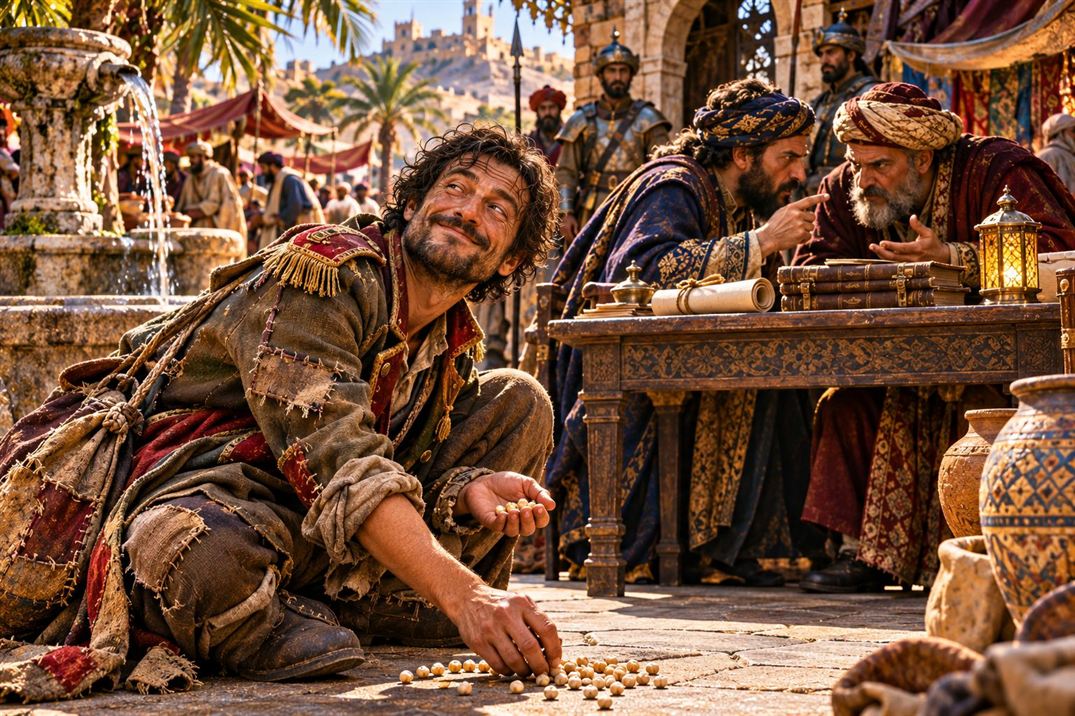
The most dangerous strategic mistake is to confuse the appearance of helplessness with a lack of intelligence, granting your adversary the freedom to discover your weaknesses.
On the edge of a marketplace raised beside an oasis, where merchants haggled over the price of goods and guards inspected the caravans arriving from the desert, I met a man who, by his appearance, seemed to be a stray soldier. He wore a threadbare military tunic and an old cap, and carried a patched knapsack on his shoulder. He talked to himself and liked to count the pebbles beside the well, forever losing track of the numbers. Every now and then he burst into laughter so out of place that passersby looked at him with pity or contempt. Some called him “the Scatterbrain”; others sent him off on pointless errands, merely to amuse themselves at his expense.
The strange thing was that the man never seemed offended. On the contrary, he received the mockery with an almost childlike cheerfulness, carrying out without objection any task that allowed him to enter the building of the market’s administration. Sometimes he brought water to the officials; at other times he swept the corridors or searched for objects he was told had been lost. In time, the guards stopped asking him who he was, where he came from, or why he lingered so long near the men of power. Besides, they considered him too inept to understand what he saw and too insignificant to pose any danger.
One morning I caught him listening to a quarrel between two clerks. When one of them mentioned some missing ledgers, the Scatterbrain dropped his knapsack and began, with great effort, to gather a few chickpeas scattered across the floor. The clerks laughed and carried on with their dispute. Only I noticed that the man had not missed a single word of what had been said. His naivety had a suspicious precision. I began to suspect that beneath the appearance of a simpleton lay an intelligence so subtle that it led others to reveal their own secrets, without ever suspecting they were being watched.
Can you intervene in the order of events set in motion by an authority foreign to you, when adapting to circumstances requires you to play a role different from your true identity?
A well-hidden intelligence can turn the contempt of others into an advantage, using their prejudices to learn their secrets. Therefore, one of the most important qualities of a strategist is the ability to enter circles of influence unnoticed, presenting himself to others as a man so insignificant that no one deems it necessary to look into his true identity.
Well, that shabby man reminded me of Ivan Turbincă, the mischievous soldier from Ion Creangă’s tale. With the look of a carouser without much sense, Ivan enters a haunted house and traps the devils in his enchanted knapsack. Later, he even comes to terrify them in Hell itself, using the same unusual weapon. Pașol na turbincă! What to the devils seemed an encounter with a harmless soldier turns into a confrontation with an adversary they had fatally underestimated.
Ivan’s cleverness lies not only in the power of the enchanted object, but also in the way he exploits the arrogance of his adversaries. The devils let him come close precisely because they do not consider him dangerous. In effect, they themselves give him the freedom of movement he needs to capture them. This is the subtlety of strategy: the best disguise does not always conceal the true face of the one who wears it, but sometimes his very intelligence. The adversary’s contempt can become the surest form of camouflage.
Can you identify the vulnerable point of a power structure, in a context dominated by hidden complicities, without compromising the strategy by which you seek to reveal the truth?
Something similar was happening in the marketplace. Two factions within the structures of power were vying for control of the guards, of the administrative inspections, and of the judicial rulings. One had gained the advantage thanks to the skill and integrity of its people; the other, unable to match their competence, had begun to use dishonest means to undermine the authority of its rivals and impose its own interests. False accusations against innocent merchants had appeared in the ledgers, and institutional rivalry had come to serve personal interests. The more officials took part in the forgeries, the greater the danger that a single one might expose the entire mechanism. Every new accomplice became a potential weak link.
One evening, the man with the knapsack was called to clean the archive room. There he noticed that a young clerk, whose superiors had ordered him to replace certain documents, was struggling to hide his unease. He then began humming a nonsensical tune, and asked him whether old parchment burns faster than new. The clerk gave a start.
“Why do you ask?”
“Because only a fool would burn the original before finding out who asked him to replace it,” the man replied, without losing his smile.
For the first time, the young clerk looked differently at the one nicknamed “the Scatterbrain.” In the days that followed, he asked to speak with a judge who belonged to neither of the two factions, bringing with him the original ledgers and the correspondence in which the alterations had been demanded of him. Only then did it come to light that the man with the knapsack had been sent by an independent authority, charged with investigating the abuses without favoring either of the rival groups. He had not sought to prove a guilt determined in advance, but to find the weak link of the conspiracy: the man capable of opening the way to verifiable evidence. The knapsack had been merely the prop of a flawless dissimulation.
How can you change the scenery of a reality imposed by others, when the recognition of your true identity depends on your ability to play a role no one suspects?
When I asked him why he had allowed himself to be humiliated for so long, the man straightened his back, took off his shabby cap, and answered me with surprising lucidity:
“Had I shown myself capable from the start, every step I took would have been scrutinized and I would have been allowed no freedom of movement. But, deeming me «scatterbrained», they did not even bother to find out who I was, considering me easy to manipulate and incapable of threatening their plans. And so I let them multiply their own mistakes. I did not need to catch them all, but to find a single one willing to tell the truth. From now on, the evidence will speak before the judge. My mission has come to an end.”
And so, I wrote in my book of sand:
“I met a man who had entered a world ruled by rivalry and deceit, hiding his shrewdness beneath the appearance of an incompetent, in order to uncover the secrets that the men of power concealed even from their own accomplices. He had let his adversaries trust in their own superiority and commit mistakes without fear of being discovered, until every attempt to hide the truth began to furnish new evidence against their own schemes. Only then did his true strategic mastery come to light.
After all, a conspiracy does not become safer through the number of those involved, for every new complicity may bring with it a rivalry capable of hastening its unraveling. And the most skillful strategist is not the one who forces his adversaries to reveal their intentions, but the one who knows how to recognize the weaknesses that may lead them to betray one another.”
The greatest vulnerability of a conspiracy is not the existence of an external enemy, but each accomplice’s fear of being betrayed by the others.
The Triumph of Hidden Intelligence is the expression of a strategic superiority gained through the art of turning the adversary’s underestimation into an instrument of his defeat.
Thus, the knapsack of the man no one suspected was not an enchanted object, like the one in Creangă’s tale, but the symbol of a strategy founded on dissimulation and the knowledge of human weaknesses. The Scatterbrain had not triumphed through force, nor through the means of power, but by making use of his adversaries’ conviction that a man of no importance could pose no threat. And when his true identity came to light, those who had laughed at him discovered that, all along, the only ones who had failed to understand the game had been themselves.
The greatest skill of a strategist is to hide his superiority until the moment when the adversary can no longer use anything against him.


