
Fragmentum Aeternum
What seems worthless to a superficial glance becomes revealing to an eye educated to see beyond appearances.
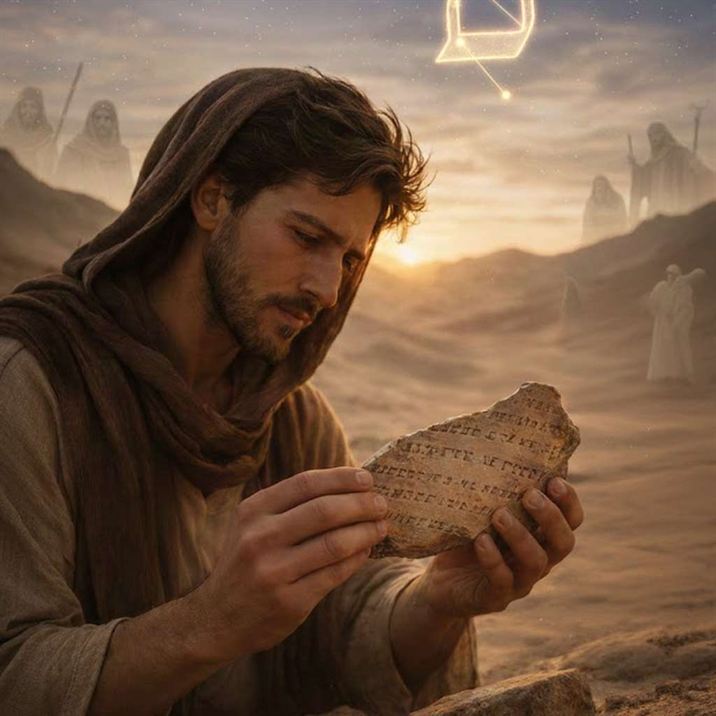
In that nameless desert, where the sand erases all traces, I found a piece of broken pottery, half buried under a dune. When I picked it up, I saw old inscriptions on it, partially erased by wind and time. They were not complete words, but fragments of sentences, as if someone had started to write something and stopped halfway. I sat for a long time with the fragment in my hand, looking at it, trying to decipher what its forgotten author wanted to say. Then I realized that I should not decipher, but complete. What is not finished waits for someone else to finish. Writing unites times that do not meet.
Every unfinished text is a call to the one who knows how to read between the lines. Thus, I understood that writing is not just a static record, but a transformation of what was left incomplete. That fragment of pottery was not just a memory, but a responsibility. I had to continue the story, to transform it from something broken into something whole, from something forgotten into something alive. From something inert into something pulsating. In that moment, I felt that I had not found him, but he had found me, waiting for me to give him the meaning he lacked.
The true writer is not the one who starts new stories, but the one who continues the stories left unfinished by others. And if what I write now is a thread of meaning unfinished by the one who lived before me, pulsating like an old heart still waiting to be heard, and if what emerges between the lines does not belong to me fully, then all that remains for me is to write humbly, knowing that each word carries forward an invisible presence. For this is what happens when an untold story calls you: you must answer the call of an ancestral echo, beyond your own need to be the full author.
Do you take responsibility for transforming the incompleteness of the past into a form of living continuity, providing purpose where others have left only oblivion?
In Umberto Eco's novel The Name of the Rose, the hidden library in the monastery contained incomplete texts, fragments of wisdom waiting to be rediscovered and reinterpreted. Likewise, the fragment of pottery I found did not have a complete message, but the act of completing it had become the message itself. I began to write on the back of the fragment, continuing the ancient inscription with my own words, transforming two halves into a whole. It was not just writing, but a Scriptio Continuata– a living connection between times, between people who had never met, but who shared the same need to leave something behind.
Like a mosaicist who finds a missing piece and puts it in its place, I felt that that fragment chose me to finish it. It was not about my glory or my recognition, but about the duty to complete what another could not finish. At the same time, I understood that each text I write is not only mine, but is part of a larger work, an infinite puzzle in which each writer adds a piece. Completing an unfinished fragment is the act by which time becomes eternity and writing becomes a bridge between generations. And the truth lies neither in light nor in shadow, but in the pulse that makes them inseparable.
Does your being become a living echo, under the careful direction of a memory that demands to be transmitted, but from which you will not be able to detach yourself without betraying what chose you to continue?
I kept the ceramic fragment and, every evening, when I write, I have it next to me as a reminder, as a kind of talisman of continuity, thus feeling that I am never alone in front of the blank sheet of paper, as the result of an uninterrupted dialogue over the centuries. It is not just a banal object, but a living lesson in what it means to be a writer. I write not only for myself, but also for those who wrote before me and for those who will write after me. Every word I put on paper is a completion of a larger fragment, a piece of a puzzle that will never be finished.
Just like in the novel "The Name of the Rose", I express the same melancholy as Adso in front of the fragments saved from oblivion:
"These unfinished pages have accompanied me for the rest of my life. I have often studied them as if they were an oracle, and it even seems to me that what I wrote then, on these sheets, which you, the unknown reader, are reading, is nothing more than a mixture, a carne a figura, that is, a story with pictures, an endless acrostic that says and repeats only what those fragments whispered to me, and I no longer know whether until now I have spoken about them or they have spoken through my mouth.
But, whatever the truth of the two situations, the more I read the story here to myself, the less I succeed in understanding whether there is any plot in it that goes beyond the natural unfolding of events and times that enclose it. And it is difficult to understand for someone like me, in the shadow of those who wrote before, not to know whether the letter he wrote contains some hidden meaning in it or whether it has more than one, and many, or none at all."
Are you building a work with temporal exposure, in which vision becomes an impactful image, in a reconstruction of meaning that connects generations through emotional resonance?
In this sense, the writing I have crafted, with so much rigor, becomes an act of responsibility towards the past and the future, simultaneously – a Fidelitas Temporisthat transcends the moment and transforms words into invisible but living bridges between generations. Nothing surprising, except that every new line seems like a loan, given my finiteness in the face of sacred language. In these circumstances, I realize that I am only a copyist of a previous inspiration, which has let a name slip away, under the permanent and controlled direction of the living memory of humanity, from which I will never be able to separate myself. Continuity gives meaning to forgotten fragments.
And so, the desert scribe wrote in his sand book:
"Nothing is truly unfinished if there is someone willing to complete it. The fragment is not a ruin, but an invitation. And the one who accepts the invitation becomes part of the work of those who wrote before him, continuing a chain that will never be broken. For my part, I will assume Adso's destiny: that of searching, of striving to find, to penetrate, to decipher the meanings, beyond the summary forms behind which, often, the work of art is hidden, sometimes with great refinement and crystallization."
Leadership is manifested through the ability to see in every discovery a calling, transforming what seems incomplete into a living work that unites the past with the future.
Fragmentum Aeternum is the symbol of that ceramic shard that taught me that writing is not just a record of the fragile past, but a continuation of a mysterious dialogue with what has not yet been spoken. What seems unfinished is just waiting for the right one to complete it. What seems broken must be rewoven with care and patience.
In that desolate desert, I understood that each text I write is a piece of an infinite mosaic, where writers from all times collaborate on the same work – the work of living memory, which never dies. And I also know, but I am not yet sure of what I will discover in the message between the lines, that I will have to recompose and decompose the words, the meanings, the expressions, when the intention of the text requires it, without seeking a definitive conclusion.


