
Opus Destinatum
Your purpose is revealed to you only when you understand that you are not separate from what you create.
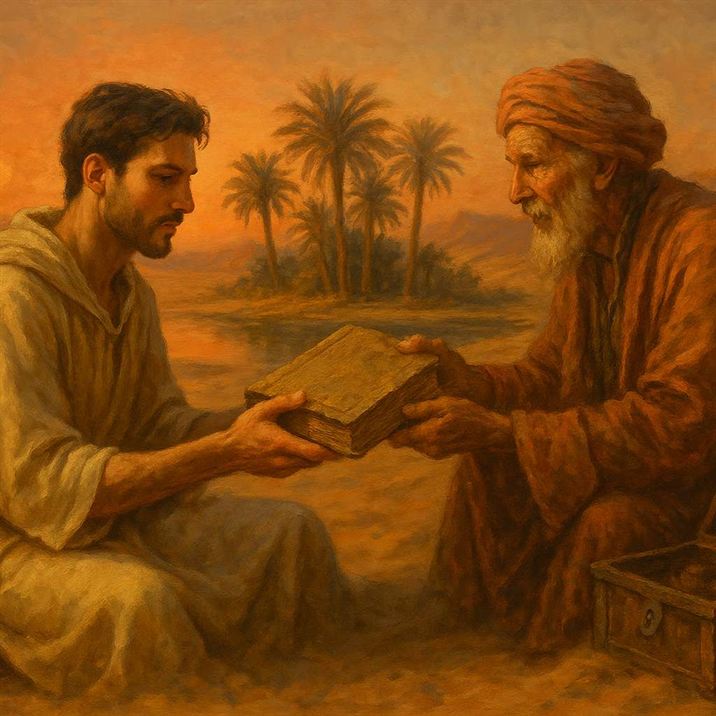
On the thirty-second day of my wanderings in the desert, as the sun was sinking toward the horizon, I met an antiques dealer who offered me, for a few copper coins, an old, dusty book. He claimed that it had been buried in the sand for more than 500 years. And on the first page, between centuries-old lines, was a fresco drawn on a collapsed wall. The painting depicted a scribe with his eyes closed, holding an open book in his hand, and from the pages of that book flowed rivers of light that turned into stars. What a coincidence!
Under the image, in imperfect Latin, was written: "Vita praeparatio, opus revelatio"- Life is preparation, work is revelation.
At that moment, under the reddish light of the sunset, something broke inside me like an ancient seal, releasing an understanding that had been waiting for years to be recognized. With a clarity that made me tremble, I realized that everything I had experienced up to that moment, my entire seemingly chaotic and fragmented life, had in fact been a continuous preparation for the work I was destined to create. Every failure that I had considered a tragedy, every loss that had crushed me, every moment of doubt that had overwhelmed me—all of these had not been absurd occurrences, but necessary steps toward the understanding for which I had been put on this earth. The inner gaze is the microscope of the creative soul.
When your life becomes a form of self-expression, is there anything left for you to create or perceive through the intensity of living?
The solution to the existential torment that had haunted me for so many years lay, of course, in that feeling of total merging with my work, that is, in the accomplishment of good through active creation. I was not just a creator of works separate from myself, but I had become the living work itself that I created day by day through every thought, through every action, through every conscious choice to contribute to the universal good. Man's work is the silent mirror of his soul. And my work was life itself lived with meaning, through the shaping of reality through creation.
It was the same conviction that the great Persian poet Rumi had repeatedly repeated in his verses, invoking the supreme authority of the divine poetic voice that speaks through all true artists: “You are not a drop in the ocean, you are the entire ocean in a drop.”It was this understanding that radically transformed my perception of my own existence, for I understood with clarity that I was no longer an insignificant fragment creating small works, but rather the unique manifestation of the universal creative force working through me. The creative spirit is living proof of immortality.
Can you view your life as a visual composition in which the balance between creation and reflection defines how you choose to make sense of a higher revelation?
In the novel "Steppenwolf" by Hermann Hesse, the protagonist Harry Haller discovers, after a lifetime of suffering, that all his painful experiences were not strokes of fate, but a necessary process of breaking down the false ego to allow the birth of the authentic self. In the "Magic Theater" at the end of the book, Haller understands that his life was not a series of failures, but a progressive initiation into understanding the multiple facets of his being.
Like Haller, I understood on that scorching day in the desert that I shouldn't regret anything from the past, from everything I've experienced, because everything was preparation for a unique moment of revelation.
And that profound inspiration that I experienced then I find right now in the steadfast conviction of building a new work — however modest — intended to join the universal aspiration to overcome evil and accomplish good. It is about contributing to that little good that has ensured, through the grace of divine providence, the survival and gradual elevation of humanity over the millennia. Undoubtedly, everything that we have given to the world through knowledge and spread slowly but strongly, through the unseen networks of the world, has become a living fire that has ignited other minds. Creating is the only way to discover yourself: authentically and spiritually.
Can you retrospectively transform your life experiences into a coherent story that reveals its ultimate purpose only when everything becomes necessary for the accomplishment of the Supreme Work?
The call to work — Vocatio Operis— is, at the same time, the call to myself. For I was certainly not called to make brilliant and ephemeral works to validate my existence, but existence itself is the supreme work that I created daily through the way I chose to live, think and act. The meaning of a life is not confirmed by the looks of others, but by the depth with which it becomes a response to an inner calling.
To put it another way, the supreme work is what becomes visible within you when you align your life with the profound meaning of your own calling, that is, the result of what you have cultivated with patience, discernment, and fidelity to what you have discovered along the way, to what has not been told.
In fact, every person carries within themselves a unique work, waiting to be brought to light — a small spark of science, of creation, that can ignite the consciousness of the entire world. And even if not everyone is called to create masterpieces capable of remaining in history, each one is nevertheless called to live with an intensity and authenticity that transforms their own life into a work of art. This creative power of which I speak is not obsessive productivity or meaningless activism, but a state of grace in which each gesture becomes sacred through the intention that animates it. Sometimes it doesn't matter how much you create, but how much you illuminate with who you are.
Spiritual leadership consists of fully accepting that your entire life, with all its painful and confusing experiences, has been a preparation for the work that only you can accomplish in its unique and unrepeatable form. It means remaining true to your inner calling when everything around you seems dictated by chance.
Opus Destinatum teaches us that nothing in our lives is accidental or useless for the Supreme Work—the transformation of our own existence into a living testimony to the power of good to triumph over evil, through creative persistence.
Well, the fresco on the first page of an old book revealed to me that the scribe with closed eyes does not sleep, but sees more clearly than people with open eyes, because he looks within, where his real work is written not with ink on parchment, but with the very essence of his being transformed through each consciously lived experience. For the Supreme Work is not what we leave behind on paper or in stone, but what we become through the continuous creative process: of transforming ourselves from raw matter into conscious instruments of universal good.
Perhaps life is nothing more than a vast and silent preparation for the work you are meant to do. And its ultimate meaning is revealed when you and your creation become one essence.


