
The Ace In The Sleeve Law
At the game table, a game cannot be considered lost as long as you have one last card.
One dream, one burning desire did Mehmed II have: to greatly surpass the deeds of his grandfather, Bayezid, and his father's, Murad, who have proved Europe for the first time the military supremacy of the Turkish nation. And, in order to prove his real qualities of a good leader, a fact that could have quickly propelled him among the most popular and loved sultans, decided to conquer at any cost Byzantium, the last jewel of the empire of Constantine Dragases (Constantine XI Palaiologos).
Blinded by ambition, greedy of power, he built an army of almost 150,000 soldiers, calling under arms all the valid men of all the four corners of the Ottoman Empire. But Byzantium, which had extraordinarily resistant circular outer defense walls, foreseen with crenels and openings, protected by ditches of water, guarded by massive square towers, cannot be easily conquered at all. No city in Europe was better and heavier defended as Byzantium; those massive blocks of stone had defied all known war machines. Ram hits and projectiles thrown by the most powerful mortars and cannons of that time were made useless in front of those abrupt walls. Besides, Constantine, knowing very well what Mehmed was planning, in spite his restless messages of peace, immediately asked the help of the Christian world in Europe.
Have you honed your skills by using the "coincidence of destiny" to overcome a grand challenge and define yourself as a "creator of a new world"?
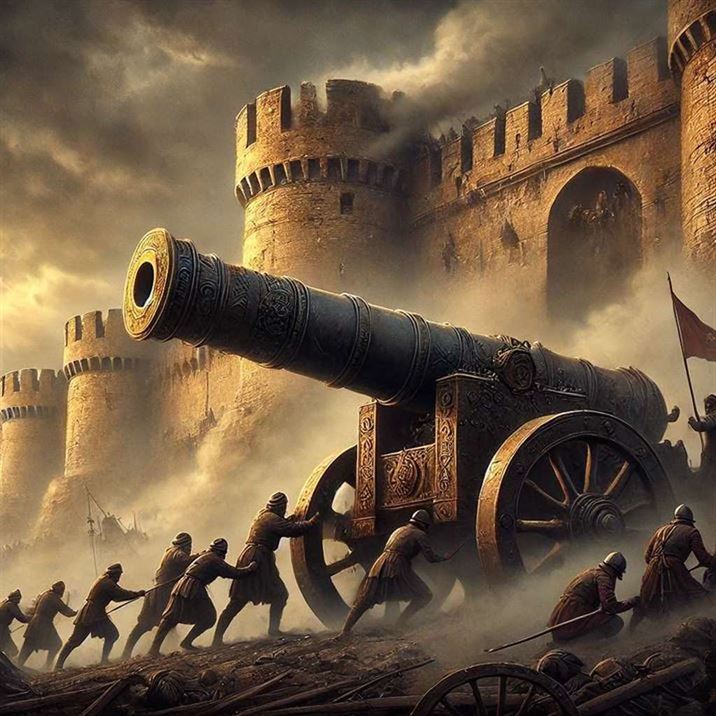
For strong walls, strong cannons. Thanks to the most ingenious and experienced cannon founder in the world at that time, a Romanian called Orban, by Mehmed's orders, in a very short time, some huge cannons were built, with a very long range, the stone projectiles of which had the power to destroy walls from one strike. An entire army, an entire nation, for two months has carried 20-30 such colossi to Byzantium. The battle begins. Everyday, the walls are shaken by countless projectiles, the fortifications are made a riddle. The Byzantines suffer.
But hope never let itself be awaited for too long, as you can see it exactly when you most need it. Help from Europe appears. Four huge ships, well armed, carrying a pretty large crew, loaded with all sorts of supplies, succeed in entering the safe harbor of Byzantium. At this moment, Mehmed realizes that his chances begin to fall more and more. In the coming weeks and months, more and more help will come in the aid of Byzantium and he will face more and more obstacles and, who knows, maybe he won't be able to conquer the city any more, and his dream will only remain a dream.
Beyond the starting hands stands the unwavering willingness to give a fatal blow to the strict rules of history.
Does the way you interpret the meaning of the world and life influence your relationship to a power ruled by luck, but which can be defeated by the divine sign?
When the jackpot is huge, you either have good cards and control over them, and you go further, or, if not, you withdraw. And Mehmed knows how to interpret a miracle when it is precisely through the desperation of the inhabitants of the city of Byzantium to hide the disaster they are in, through their desperation to find help in the great powers of Europe. But no one casts a merciful glance upon the one near death, no one raises his hand to save a relic, a ghost of the past. The divine sign only favors Him.
A powerful man, ambitious all the way, just like Mehmed, can be neither persuaded, nor intimidated by anyone or anything. Once he has set himself a goal, no matter how hard it would be to reach it, he doesn't quit easily, his attitude being ever more unshakeable, his will, ever more trenchant. For Mehmed, the bigger the jackpot, the greater the temptation to go further, the more he needs to risk everything precious for him, the more he hardens in order to win, even though the risks are too many and too high.
Controlled by ecstasy, just like a poker player who knows he's one cart short in order to win the game, Mehmed doesn't think that much and immediately and forcefully steps in. He must be the Creator of the New World, faithful to a purely materialistic, personal, therefore less religious vision, ready at any time to sacrifice himself for his ideal of superiority, thus giving a fatal blow to the strict rules of history that guaranteed Byzantine stability for a long period of time.
This is what characterizes the most feared leaders – they don't tend to overburden themselves with any kind of hesitations, they get straight to the action, aiming straight at the heart, off hand, with no hesitation, all his opponents, annihilating any trace of resistance.
Is the foundation of your life based on themes such as success, facing destiny and pushing your limits under the motto "Always remember your greatness"?
Check-Raise. There's nothing worse than wrongfully judging a fearless and capable man, a real player, who knows how to turn the result in his favor.
Mehmed knew he had only one chance to conquer Byzantium, only if the four Christian ships would be immediately destroyed and sunk down. But his fleet couldn't enter the bay directly, since the Genovese city Galata, the neutrality of which he had to respect, guarded the entrance. The Christian ships could only be attacked from the inside bay, located beyond the Genovese territory. How could have he brought the fleet to the interior waters?
While joy and hope filled the hearts of those under siege, Mehmed devised a plan of such fantastic daringness that it would fully deserve to have a place in the history of wars, next to the most courageous feats of Hannibal and Napoleon.
Greatness is man's chance to assert himself in history as a master of chance, capable of changing the course of the world: "Be ready to act without limits when the time comes to fulfill your purpose."
His genius plan, that of transporting his fleet, the hundreds of ships, over the highlands, and in to the bay, was perfectly put to practice and ended in success. In only one night, in less than 10 hours, seventy ships were carried from one sea to another, over mountains and valleys, through vineyards, fields and forests.
The next day at dawn, the Byzantines, who did not consider in their plans such and absurd and impossible idea, were stunned; they couldn't understand how the miracle happened.
It was only at that key moment that both players, Constantine and Mehmed, knew precisely which of them would win the table – the one who played his last card best, the one who was the most considerate and efficient, the most cunning and nimble - that is Mehmed.
The winner is not the one who has the best cards, but the one who knows how to play best the last card !
Victory is not won by the one who has the best cards, but by the one who knows how to play very well the cards he holds in his hands. I think that the conquest of Byzantium by Mehmed confirms this.
Mehmed did not rely solely on chance and he risked, just like a professional poker player, since risk, doubled by tenacity and ingenuity, is the greatest advantage of a poker player. He had an ace in the hole, namely a genius idea of getting out of the standstill and a great strategy to apply it. Only thanks to his special maneuver at the very last moment did he manage to do what no one else hadn't – the conquest of Byzantium
Leadership means producing a colossal impact on your past work and rewriting history, in a test of the destiny of the Creator who plays his expansionist book at the level of glory and posterity.
With no doubt, a real leader doesn't want to know the bad taste of defeat, but only the ecstasy of victory. Tenacity and effort, the ability to respond quickly, cleverness and ingenuity are his most useful traits. But those who are not urged by a strong ambition and don't have a sharp mind won't be able to win the game called Leadership.
Having an ace in the hole means having the ability to analyze situations and quickly having the right answer, always have other alternatives, even though they appear to be crazy and impossible, have the cunningness and courage to apply them in spite the apparent obstacles. The ace in the hole is always the surprise element for opponents, so you must make sure that you always have it on hand.
* Note: Stefan Zweig - Orele astrale ale omenirii, Publishing House Muzicala, 1976.


