
The Law Of Limited Ascension
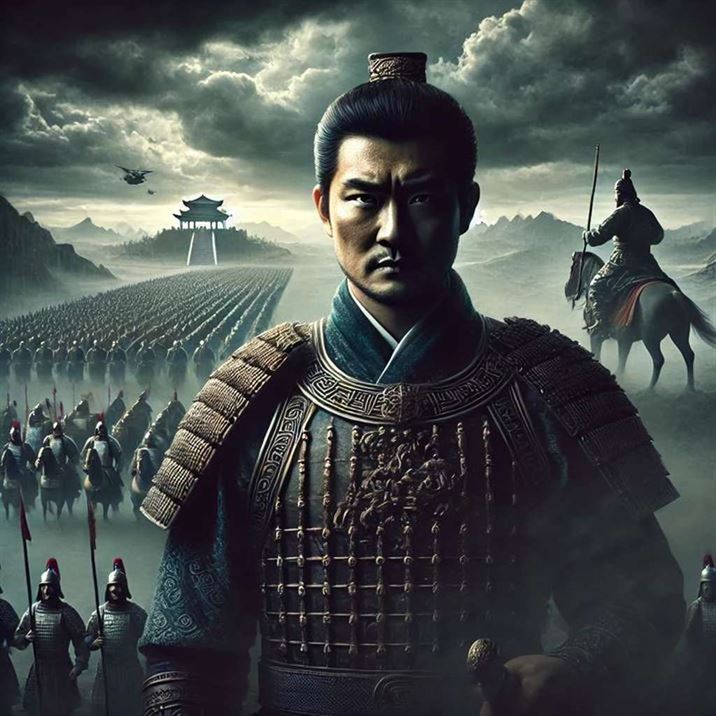
Take a clear view of reality, using the visualization of the limit as a condition of ascent in a measured course, not in a fatal contrast.
The strongest man is always driven by a single thought, because all the power he possess, the energy, intelligence and will, are used in one direction alone which he follows with holiness.
Qin Shi Huang was such a man. Since the age of 13, when he took over the throne, he had a single ambition: to bring glory to his kingdom and to unify China. At the age of 29, he decided to put his plan into practice, his lifetime obsession, that of becoming the absolute ruler. He could achieve his plan only by the force of weapons. Kingdom after kingdom, his armies destroyed everything in their way. Nobody could fight against his powerful will. And the one who tried resisting befell a terrible fate.
Do you show the valuable side of your personality after you realize that the one who has incommensurable power feels a continuous need to enhance it?
In the year 221 B.C., Qin Shi Huang becomes the absolute ruler of China. His power seems unlimited. He rules over millions of people. He is the king of everything, till Heaven. But the one who has an overly high power always feels the need to increase it. Qin Shi Huang cannot be content with his possessions, with earthly power, but like any man greedy of power, he wants more, always more. And what can mean more, can be more valuable, above all power which nobody can resist, but one: the power of being immortal? As an emperor, he feels he is entitled to the powers and the immortality of the gods.
Therefore, he needs to confront one more enemy, but an enemy he fears more than anything: death itself. He has so much to do in a single life, why losing it like any other mortal? So he starts a vast campaign, in search of the secret of eternal life. Because he is decided to spend whatever it may cost in order to fool death, he invests a fortune in all sorts of alchemists from all over the empire, one more sophisticated than the other, with various personal recipes who promise him the elixir of life together with other spells beyond imagination, meant to offer him immortality.
Are you establishing yourself as party to an agreement set in a context of guilt, acting on the premise that whoever possesses something is forever haunted by the fear of losing it?
One single thought consumes the emperor: the life-giving cure, the magical fluid which can make him immortal. He cannot think of anything else. He perseveres in his search for years. But his health starts deteriorating because of stress, anger, anxiety which continuously torture him, and with all liquors from the so-called alchemists, nothing can stop his aging.
Just like a sick man on his deathbed, whose heath condition becomes crankier, the emperor, physically tired, still hopes for a miracle. Any illness, pain or suffering can be cured if he finds the elixir in time !
Do you rely, in the confrontation with the destiny of your own work, on the hypothesis of the irreversibility of the process triggered by the beginning of the fall?
The patient being in the terminal stage of his illness has a last chance of being saved. One of the alchemists who come to see the emperor, or maybe one of his doctors, gives him a mysterious liquid which can surely cure him: the mercury (a highly toxic substance). Several grams carefully administrated can guarantee immortality to the patient. So the emperor, anxiously, full of hope, swallows some pills containing the fluid meant to make him immortal. And, ironically, he dies.
A leader’s work is not built on estimating the vulnerability of his own forces in the face of the road he builds for himself, but on the background of the change in self-consciousness that affects the assumption of his role in society. The wise words proves to be true again: "You cannot escape what you fear most." You cannot fight destiny. It will catch up to you, no matter what you do. In front of unavoidable death, people often fool themselves with the most impossible thoughts and hopes, but just as nobody can stop night to fall, no man can escape the implacable destiny.
What is the limit to which you can accede by the accepted means of power and glory, taking into account the variant of self-image that does not follow criteria other than “superlative value”?
A brilliant strategist, ambitious all the way through, Qin Shi Huang conquered all of China, which bears his name up to our days. An extraordinary desire of life laid in his heart, which was intensified by a great desire to have power and glory that he wanted to keep on satisfying. But after so many conquests, he fell into a deep state of depression. Because when a man possesses something very precious, he is always haunted by the fear of losing his possessions. And nothing is sadder for such a man than the feeling that death will separate him from his dreams.
Throughout his life, the emperor got all that he wanted, power, wealth and glory. But all these didn't make him freer, but on the contrary, they handcuffed him. He became the prisoner of his inability to obtain more than could have - just like a climber who, after much struggle, reaches the top of the highest mountain, and absorbed by the amazing view which appears in front of his eyes, doesn't want to dismount anymore, but to rise even higher. But there is no such thing as higher ! But the emperor, trying to achieve immortality, wanted to overcome human limits, which is impossible, and "the elixirs of eternal life" had only helped him to collapse sooner. Indeed, when a strong desire blinds a man, nobody can open his eyes anymore.
Every climb has its hill, that's what emperor Qin Shi Huang didn't want to accept on any terms. From the moment he started to fed himself with the illusion that he can fool destiny, embittering to live forever, everything changed. And the road to failure was growing even shorter.
The limit to which you can accede by the accepted means of power and glory is given by the point where the consciousness of a falling from a height and the acceptance of a reality that exists beyond what you think is reality meet.
Conclusion: Everyone have their limits. And every intelligent man knows his limits, and when he realizes he reached the maximum limit, he is content with his achievements. Lingering and acting in order to surpass some possible limits won't attract benefits, but will cause his quick decline, and even collapse.


