
Vates Deserti
The true prophet is not the one who sees the future, but the one who reads the present with eyes unclouded by illusion.
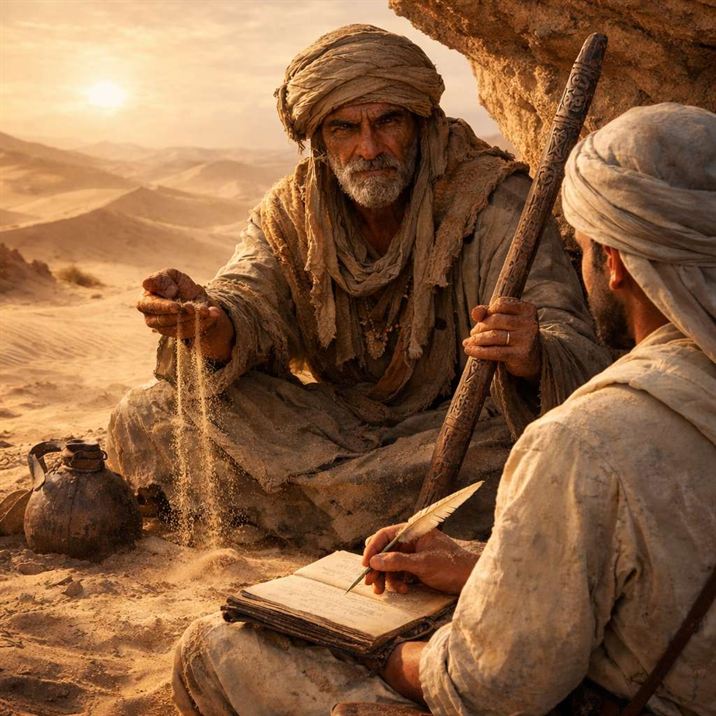
One day when the sun seemed to burn closer to the ground, I met a strange man in the desert. He was not a Bedouin, he was not a wanderer, he was not a merchant. He was a poet – I knew this before he told me, just from the way he looked at the dunes, as if he were reading verses in the curves of the sand. He wore old, worn clothes, faded by the sun, and in his hand he held a stick on which were engraved signs that I did not recognize. He stopped in front of me and looked at me for a long time, without blinking, as if he were searching for something behind my eyes.
Meetings that seem random are often the most precise arrangements of destiny.
"You are the scribe," he said, not as a question, but as a statement. I didn't ask him how he knew. In the desert, such questions make no sense. Some meetings are written before they happen. People know what they need to know, and the rest is left unsaid. Then he invited me to sit beside him, in the shade of a stone pillar, and offered me water from a skin. I drank in silence, feeling each sip wash away not only my thirst but also my anxiety.
Are you ready to recognize a teacher in someone who doesn't present themselves as such, accepting their lesson before asking for explanations?
"Do you know what it means to be a prophet?" he asked me after a long silence, as if he were weighing the weight of his own words. I shook my head negatively, with that mute curiosity, waiting for him to continue. "The world thinks that the prophet is the one who sees the future. But it is a misunderstanding, a mirage of the mind. For the prophet does not see the future - he reads the present so deeply that the future becomes obvious."
Then he took a handful of sand and let it flow through his fingers. "Look, in every grain of sand there is a story written. Most people only see sand. The prophet sees the story that time has hidden behind each grain of sand."
Immediately, I remembered Sherlock Holmes, the one who could reconstruct a man's entire life just by looking at the dust on his shoes. Even the opposite is sometimes true: the more you look for signs in the stars, the less you understand the dust on your shoes.
But what the poet was describing was something deeper. It was not about logical deduction, but about a Videsignignum Shabi,the ability to perceive the invisible signature that reality leaves in every thing. The prophet does not guess – he recognizes. He does not invent – he discovers what was already there, hidden under the thin layer of appearances. Knowledge of the whole is directly proportional to the attention paid to the parts of which it is composed.
Do you distinguish the difference between the light that shows you the way and the glare that blinds you, knowing that one frees and the other chains?
The poet continued: "The true prophet is the one who knows how to guess what is hidden just from what he sees around him. He does not need visions or voices from heaven. It is enough for him to look at a leaf to understand the tree, a wave to know the ocean, a tear to read a whole life." He was silent for a moment, then added: "But that is not all. The prophet does not add anything to reality - he only removes the veils that we have placed over it. It is like that logic: if you look at a leaf carefully enough, the need to see the tree becomes a mere formality."
"What else is there?" I asked him, feeling that I was approaching something essential, having nothing in my soul but an unquenchable thirst for meaning. Instantly, the poet turned to me, as a witness to ancient mysteries turns to silence, and in his eyes I saw a light that came not from the sun, but from the unknown depths of being. And he said to me:
"The prophet understands that everything is written by the same hand. Every event, every encounter, every suffering and every joy – they all bear the same signature. When you understand this, there are no more coincidences. There are no more happenings. There is just a story unfolding, and you are both a character and a reader."
Can you let go of your reflection in the mirror of the world, knowing that no individual action can step outside the sphere of influence of the One Author?
It was as if he had described what I had been searching for all my life, without knowing what I was searching for. A person lives and reads his own story simultaneously. In fact, it seemed like something out of the novel “The Master and Margarita,” in which Woland states: “Manuscripts do not burn.” However, the poet in front of me was telling me something even more profound: that there is only one manuscript, written by one hand, and that we are all characters in the same book. So, I was no longer alone in the face of fate – I was part of a narrative that encompassed me and surpassed me at the same time.
"The hardest thing is not to confuse light with its reflection," said the poet, standing up. He pointed to the sun, then to the sheen of the sand that mirrored it.
"Many follow the reflection, thinking they are following the source. They worship the mirror instead of seeking what the mirror reflects. The prophet knows the difference. He does not stop at the image, but goes to the origin. The real difficulty is not in seeing the light, but in refusing to stop at the first reflection that steals your gaze. Remember, if you follow the glitter on the ground, you will always end up with your face in the dust. And the prophet is the one who looks up to the source, ignoring the deceptive reflections along the way."
Can you see beyond what is shown, without confusing light with its reflection and truth with its echo?
I remained silent, letting the words sink in. The poet placed his hand on my shoulder and spoke for the last time: "Do not be afraid to bring the truth where words are scattered by the wind. The desert erases the tracks, but it does not erase the meaning of the path. You can speak in the storm and no one will hear you – but your words will remain in the sand, waiting to be found by the one who knows how to search."
It was a Verbum-Mortis, the sacred word that survives the disappearance of its speaker, the seed of meaning cast into the wilderness with the belief that it would sprout in the right mind, at the right time. Somehow, the poet taught me that day that the prophet is not he who shouts the loudest, but he who speaks even when no one listens, knowing that the truth has its own patience until it manifests itself in the world. The future is only the present that has been allowed to flow uninterrupted; and he who sees the stream of water today, does not need visions to know where the sea will be tomorrow.
Can you assume the role of witness to events, by reducing the present to its essence, transforming simple perception into a revelation that underpins your own destiny?
A moment passed like a breath of wind on a dune, like an echo lost in the immensity. By the time I wanted to thank him, the poet was gone. Perhaps he hadn't even been there in the usual sense of presence. Or perhaps he had been more present than anyone I had ever met—present in the way that life-changing dreams are present, even if you can't reach them.
And so, the desert scribe wrote in his sand book:
"I learned from an unnamed poet that the prophet does not predict, but perceives. He does not guess the future, but reads the present to its ultimate essence. He sees in each fragment the signature of the whole and understands that a single hand has written everything – from the first star to the last grain of sand. He does not confuse the mirror with the light and does not remain silent even when the wind scatters his words. For the truth does not need witnesses to be true – it only needs someone to speak it, even in the desert, even in the storm. In due time, it will become destiny."
Leadership is defined by the courage to stand for the truth even in the absence of a receptive audience, based on integrity towards one's own vision, not the reaction of others.
Vates Deserti is the symbol of that poet who taught me that the prophet is not a fortune teller, but a reader of reality who refuses to stop at describing the facts. In that unexpected encounter, I understood that to truly see means to recognize the unique hand behind all things, and not to confuse reflection with its source.
After all, the true prophet is not the one who sees more than others, but the one who looks deeper into what everyone sees – and finds there the invisible signature of a story that encompasses us all.


